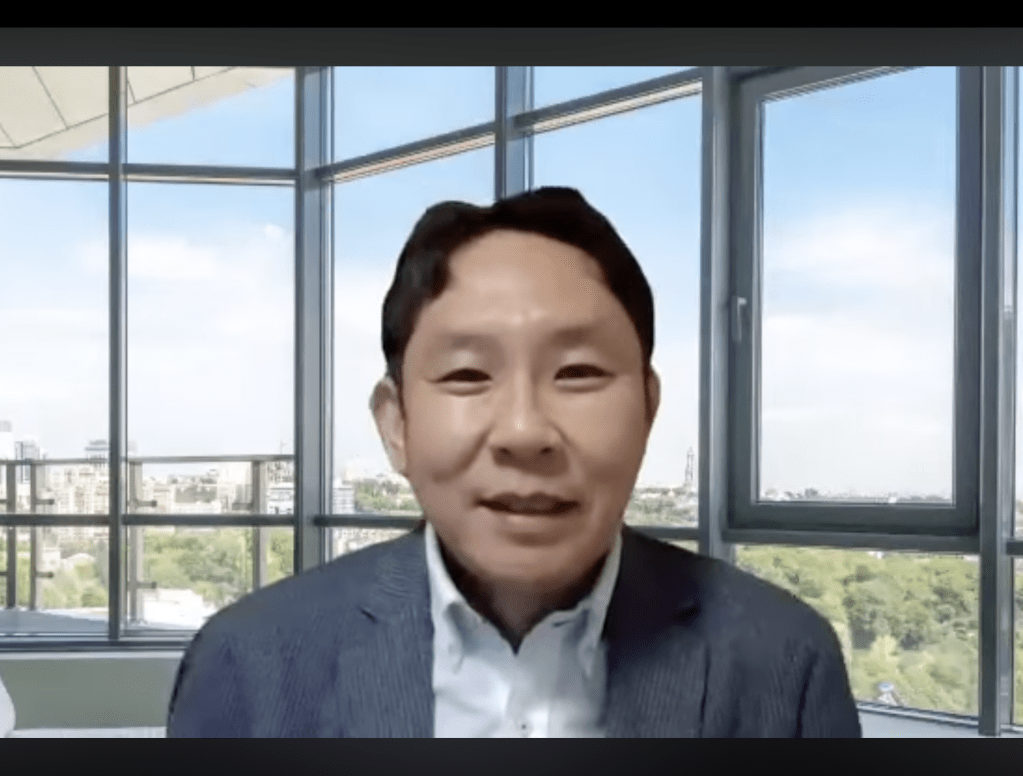
Video of Prof. Chijiwa Yasuaki discussing in Japanese certain key points:
- What Japan’s friendship to the U.S. looks like today
- How deep wounds from WWII remain between Japan and the U.S.
- What the U.S. “misunderstands” about the defense treaty and burden of the bases
- How Japan is proactively expanding its security role
- Why minilateralism is more realistic than an “Asian NATO”
See below for Prof. Chijiwa’s bio and English transcript of the interview, which has been edited for flow and clarity. Click here for the Japanese transcript.
Chijiwa Yasuaki Bio
Prof. Chijiwa Yasuaki studied political science at the school of law in Hiroshima University. He then went on to grad school at Osaka University, where he studied international public policy. In 2004 he went to Washington, D.C. to study at George Washington University’s Elliott School of International Relations, at the Sigur Center for Asian Studies. He then obtained his doctorate upon returning to Japan.
While continuing his research Prof. Chijiwa had other postings as well, such as part-time lecturer at Kansai Gaidai University, and history instructor at the National Institute for Defense Studies (NIDS) specializing in WWII and postwar Japan. He also served in the Cabinet Secretariat doing work on security and crisis management.
Prof. Chijiwa taught at NIDS from 2009 until 2026, and recently became an associate professor at Nihon University. He has written many books and essays, such as: Who Made Japan Surrender? (「誰が日本を降伏させたか」); The Geopolitics of the Japan-U.S. Alliance (「日米同盟の地政学」); Takaichi’s Version of the Three Security Documents: What is their aim? (「高市版『安保3文書』は何を目指すのか」); Development of Defense Capabilities at the End of the Cold War (「冷戦末期の防衛力整備」; and The End of the Pacific War, and Postwar Japan-U.S. Alliance (「太平洋戦争終結と戦後日米同盟」) are but a few. Prof. Chijiwa has also been covered in the English-speaking press.
– – –
(Kafatos): Congratulations on your new position at Nihon University!
(Chijiwa): Thank you very much.
(Kafatos): What did the Japan-U.S. defense relationship look like up until 2025? What were its characteristics?
(Chijiwa): The defense relationship started in 1951 when the Japan-U.S. Defense Treaty was first signed. It was a collaboration between the provision of two elements, namely, “things” and “people.”
The “things” were the bases Japan provided to America; the “people” were the troops America provided to defend Japan. Japan was to provide America with bases – to include land, equipment, and funding – and America was to defend Japan. This exchange or cooperation formed the framework of the defense relationship.
However, when the treaty was signed in 1951, the assumption was it primarily served Japan. In other words, there wasn’t a sense this was a reciprocal arrangement between Japan and the U.S.; it was a treaty for Japan’s sake. That meant that, while Japan had an obligation to provide the U.S. with bases, America did not have a treaty-bound responsibility to defend Japan.
Since the treaty lacked reciprocity it also lacked bilateral characteristics. Japan was unhappy with this lack of equal footing because, in their view, the treaty did serve America’s interests, too. Dissatisfaction smoldered on the Japanese side.
That dissatisfaction was addressed in 1960, when the defense treaty was revised. The revisions reflected that the treaty served both Japan and America’s interests. And since the treaty was now reciprocal, it naturally had to have bilateral obligations. In other words, the treaty still stated Japan would provide bases and the U.S. would provide troops, but it also clarified that America had an obligation to defend Japan.
In this way, equality in terms of both sides having clear obligations was ensured. However, the actual content of the bilateral exchange remained “bases for troops,” which was an asymmetrical exchange. In other words, it wasn’t an exchange where each side would let the other use their bases, or where troop deployments were being exchanged. That lack of symmetry in the defense arrangement did not change with the treaty revision in 1960. In fact, that asymmetrical nature continues to this day.
So, even after the 1960 revision, the relationship was still lopsided – it was an uneven “balance sheet” – with the unspoken assumption that America was doing more for Japan by providing troops than it gained from the bases. After that, international affairs changed, and Japan’s position in the global community has also changed. And Japan has thus had to work to “adjust” or edit that lopsided balance sheet to match the changing circumstances. That, in a nutshell, is the history of the security treaty after 1960.
As for what kind of changes Japan has made, one example is the Situation Surrounding Japan Act of 1999 (a framework enabling Japanese forces to provide logistical support to the U.S. military near Japan). Recently that “near Japan” part was broadened to include places where developments greatly affect Japan’s security. And, under the second administration of Abe Shinzō in 2015, there was the Peace and Security Act as well. And, while it’s still limited, Japanese forces are now allowed to exercise collective self-defense. More recently in 2022, the Kishida administration amended three documents pertaining to national security strategy guidelines (hereafter called “the three security documents”).
So while the treaty is still asymmetrical, it is clear Japan has worked to even out that balance sheet of 1960. That is just a quick rundown of the history of the defense treaty from then to today.
(Kafatos): So, put differently, as reciprocity between the allies increased over time the relationship became more equal, right?
(Chijiwa): Technically, equality between the allies was ensured in 1960 when the mutual obligations were first codified. But even so the U.S. has pressed more and more for Japan to increase its role in defense, to make it more symmetrical. That prompted the realization that the status quo of 1960 is no good, and that is why Japan has sought to expand what it brings to the alliance.
“He simply understands the relationship to be asymmetrical… one-sided and not reciprocal.”
-Chijiwa Yasuaki, on Trump’s mistaken understanding of the Japan-U.S. alliance
(Kafatos): How is defense cooperation between Japan and the U.S. changing? Can the defense treaty fully function under the Trump administration?
(Chijiwa): To answer that we have to consider how the Trump administration views the Japan-U.S. alliance. In 2019 during his first term President Trump said this during an interview for Fox Business TV: “If Japan is attacked we will fight WWIII. We will go in and protect them… at all costs. But if we’re attacked… they can watch it on a Sony television.”
During his second term President Trump has also voiced dissatisfaction with the Japan-U.S. alliance. About a year ago at a press conference he said, “We (America) have to protect them but they don’t have to protect us.”
As I said earlier, it’s true our collaboration – bases for troops – is not a symmetrical exchange. However, it is a reciprocal relationship, and Japan has adjusted to make it more bilateral. History shows Japan has made efforts to make it a more equal relationship.
But President Trump probably does not have a careful understanding of how this history unfolded. We can infer he simply understands the relationship to be asymmetrical. That he thinks it’s one-sided and not reciprocal.
This ties into the belief that it’s a one-way street, that America is “being used” by Japan. This can also be seen in the Trump administration’s view of alliances in general – the idea that allies are liabilities, not assets. This seems to be the belief underlying the views he has expressed. But if this kind of short-sighted thinking is applied – where he says this relationship is asymmetrical, it’s only a one-way street – that raises a serious issue: it basically brings us back to the days of the old treaty of 1960, where the thinking was the treaty only served Japan’s interests and not America’s.
If indeed the Trump administration is operating on this faulty premise, then we need to carefully explain why it is wrong. That, yes, it’s true this defense treaty and alliance serves Japan’s interests but it also serves America’s; that it has strategic value for America; and that strengthening Japan-U.S. security cooperation is in America’s national interests. In order to make this argument more convincing Japan has to become more self-sufficient in its defense, and take a more proactive role in the efforts. China is showing hegemonic moves in the region, and the security environment around Japan is becoming increasingly dire. We need to make solid efforts to ensure the Japan-U.S. alliance is effective.
(Kafatos): It sounds like the Trump administration has this interpretation of the alliance from back before the 1960 treaty revision. In your research have you found that U.S. defense-related people in Japan have a similar view of the alliance?
(Chijiwa): My impression is this: the Japan-U.S. defense relationship is built on a human network of various stakeholders – Japanese SDF officers, U.S. government and military personnel, and private market players. Do they all think as President Trump does? I would say no, I do not think so. It seems to be a view of alliances unique to his administration.
However, the fact is there are more Americans who are not a part of this Japan-U.S. defense network than who are. And many of those people believe America has become excessively involved in the world‘s problems and, as a result, their own livelihoods have changed for the worse. The Trump administration harnessed that dissatisfaction and rode it into power. We need to be mindful of the political atmosphere in America, and know this dissatisfaction forms a large part of the foundation of his administration’s support.
“We’re going to have to watch carefully to see how that unfolds.”
-Chijiwa Yasuaki, on whether Trumpian diplomacy is going to be the new normal in America
(Kafatos): Japan’s foreign ministry is using a diplomatic strategy for President Trump that seems to basically be “flatter him.” If that is indeed a good short-term strategy, is it really sustainable in the long-run?
(Chijiwa): I think, given the severe security environment in which Japan finds itself, the most important thing here is definitively ensuring the effectiveness of the Japan-U.S. alliance. This is diplomacy, so naturally diplomats have to take into account the personality of their counterpart. President Trump has a unique personality, so diplomats have to be very careful in their dealings with him.
Diplomats shouldn’t needlessly cause friction, so, in my opinion, carefully engaging in diplomacy with President Trump while taking into consideration his personality is totally natural. After all, the Japanese government has a responsibility to secure Japan’s defense.
With regard to maintaining a relationship with someone like President Trump, who, as we said, has this unique personality, we have to ask ourselves: is this uniqueness a temporary departure in American politics and diplomacy? Or will this type of Trumpian diplomacy and politics continue in the long run? We’re going to have to watch carefully to see how that unfolds.
If Trumpian diplomacy and politics is going to continue over the long run then America’s friend, Japan, has to continue to show solidarity as it has throughout the many years of the alliance. Japan will consider America a responsible leader in the international order, and Japan is America’s ally and shares the values of freedom, democracy, and the rule of law. It will be important for Japan to advise its friend, and try to help steer America in the right direction.
(Kafatos): One of the keywords you just mentioned was “friend.” It would seem friendship involves sometimes speaking hard truths to each other.
“There is a strong case to be made that it violates international law.”
-Chijiwa Yasuaki, speaking about the Trump administration’s attack on Iran
(Kafatos): The Japanese government clearly denounced the invasion of Ukraine, but it avoided doing so for America’s attack on Iran. Many people throughout the world think this is hypocritical. Isn’t the stance taken by Japan inconsistent with the concept of the international order, which Japan claims to want to uphold?
(Chijiwa): That is a very important question, but the conflict in Iran has aspects that differ from the Russian invasion of Ukraine, namely, the issue of Iran’s nuclear program. From the standpoint of non-proliferation, Iran’s nuclear development is a threat to the stability of the international community. So the situations in Ukraine and Iran are not necessarily the same.
However, when considering the administration’s attack on Iran from the perspective of international law, there is a strong case to be made that it violates international law. And upholding international law is referred to in the Japanese government’s three security documents issued in 2022, to the effect of “upholding international law is in line with the national interests of Japan.” By the same token, if something disrupts the international order then that would threaten Japan’s national interests.
That’s the context in which the Trump administration’s attack on Iran occurred. The Japanese government has decided to refrain from making assessments on the legality of its ally’s attack. Of course, there are various arguments for and against the stance taken by the Japanese government. However, given the security environment around Japan, and the need – now greater than ever – to ensure the effectiveness of the Japan-U.S. alliance, I believe Japan is taking the utmost care in its position.
But as you said, it’s true friends should be able to tell each other uncomfortable truths. But if that friend doesn’t want to hear it and they’re just going to get mad, then it’s pointless to do that.
Respecting international law, and maintaining and protecting the international order on which it’s based, is in Japan’s national interests. In the long run, I think it will be important for Japan to try and gradually help guide its friend, America, back into the fold.
Put differently, was America a completely blameless country prior to the Trump administration? I’m very sorry to say that was not always the case. I think there were cases where the U.S. committed various errors. Examples include the Vietnam War or Iraq War, which started because there were supposed to be weapons of mass destruction, but in reality they did not have any.
There have, of course, been cases where the U.S. worked as a partner with the common values of liberal democracy and protection of the rule of law. But that’s not to say America’s efforts always went well or did not involve errors. If you look back at the history surrounding those two conflicts, you will see Japan carefully timed its engagement and strove to maintain the relationship with America.
Japan’s stance of placing importance on international law is unshakable. However, as a friend of an America that sometimes makes mistakes, I think it will be important for Japan to continue playing a role where it constantly strives to nudge the U.S. back toward respecting international law and maintaining the global order.
(Kafatos): Speaking of the Iraq War era, back then the Bush administration said something like, “You’re either with us or against us.” If today Japan was asked, “Well, which is it? Are you with the international order? Or are you with America violating international law?” Black or white? How would Japan respond?
(Chijiwa): When people insist on deciding whether something is black or white, that tends to fan the embers of conflict. Finding ways to maintain two opposing positions – in other words, taking black and moving it into the gray and perhaps maybe eventually into the white – that takes time to work out. That kind of painstaking disposition is needed in domestic politics, and even more so in international politics.
Remember the Iraq War. Back then, America was unilateralist and considered the United Nations a hindrance. The U.S. linked up with a coalition of the willing, countries that bent to America’s will, and used force in its “war on terror.” And history shows that Japan constantly approached America and made the case for working within the UN framework, for using a UN resolution in order to impart the action with legitimacy. That is a part of the history of diplomacy in the Japan-U.S. relationship, and I believe similar efforts from Japan toward such coordination will become increasingly important.
“I think the wounds from the Pacific War (between Japan and the U.S.) remain deep to this day.”
-Chijiwa Yasuaki
(Kafatos): It’s hard to shake the feeling that the legacy of the Pacific War still taints the U.S.-Japan relationship. The atomic bombings and the attack on Pearl Harbor are, for some, still hard to forgive and wounds have yet to heal. What is your take on that?
(Chijiwa): Yes, I think the wounds from the Pacific War remain deep to this day. Take, for example, a recent painful incident related to the atomic bombings. Two movies came out in 2023, Barbie and Oppenheimer, and an image appeared online melding the two in a joking manner. It went viral on social media and the movie distribution company encouraged it. As you know, a very strong backlash occurred in Japan. That’s a pretty recent incident, and it showed us that even today there is a gap between how Japan and America perceive the atomic bombings.
President Trump has also made comments about the atomic bombings. For example, last year when talking about the 12-day war against Iran, he alluded to the atomic bombings of Hiroshima and Nagasaki, saying something to the effect of “sometimes you have to bomb like that to end wars.” He didn’t even hesitate to make that reference.
The way the atomic bombings are viewed by certain people in America is hard for Japan to accept. Public opinion in America today shows that 50% or more believe the atomic bombings were justified. They sat that view has changed among younger generations but, generally speaking, the trend hasn’t really changed. In contrast, over 80% of Japanese respondents think the atomic bombings were not justified, so there is a perception gap even to this day. And that gap comes into stark contrast when things like the Barbie/Oppenheimer incident or President Trump’s statements occur.
But this isn’t just an issue on the American side. In Japan there are discussions that sound like the stuff of conspiracy theories, where some insist the U.S. wanted to use their atomic weapons, and not necessarily just to end the war. When such statements are flying about there is a real danger of the gap between the two nations widening. Impressions and prejudices can proliferate on both sides.
That is why I think it is important to continue having coolheaded discussions, and dialogue based on the historical facts. Even though there’s still this gap, there are also beliefs the U.S. and Japan have in common. And I believe, going forward, it will be important for those common parts to be maintained and expanded upon further.
A good example of that is President Obama’s visit to Hiroshima in 2016. I think that was a big milestone. There were Americans who thought the atomic bombings were justified, and that view was – and probably still is – especially strong and deeply rooted amongst veterans. Against that backdrop, President Obama decided to go to Hiroshima. And we have to remember that those who insisted apologizing to Japan for the bombings was completely out of the question had a lot of influence. That naturally meant the president had to weigh the political risks of visiting Hiroshima.
“People should visit the Peace Memorial Park and the atomic bomb museum.”
-Chijiwa Yasuaki, on what Americans can do to help heal the wounds of WWII
But, despite that risk, President Obama decided to visit Hiroshima, a decision and action highly regarded domestically here in Japan. Meanwhile, in Japan discussions raged about whether we should demand an apology from America. The Japanese government’s stance – as seen in documents from the Abe administration – was that no such demand would be made. Instead, we would work together toward achieving a world without nuclear weapons.
So on the American side, the president accepted the risk of being politically denounced at home and went to Hiroshima. And on the Japanese side, it was decided no demand for an apology would be made. And while the respective wounds of the past have not been erased, Japan and the U.S. have made efforts like these to build a more future-oriented relationship.
After that there was the 2023 G7 Summit in Hiroshima. Then-Prime Minister Kishida invited President Biden and leaders of the G7 nations to Hiroshima, which is where he is from. It was the leaders of former friends and foes – of former Allied and Axis powers – who stood in front of the cenotaph. And Ukraine’s President Zelenskyy was also there since today his nation faces the threat of nuclear attack by Russia.
In today’s world, some seek to change the status quo with the threat of nuclear war. But the U.S., Japan, the other G7 nations, and President Zelenskyy stood together and sent a clear message: The aggressive use of nuclear weapons will not be tolerated. I think the meaningfulness of sending that message from Hiroshima far and wide was considerable.
(Kafatos): Even if such wounds cannot be entirely healed, what do you think are some effective means for improving relations and bringing comfort to those still hurt?
(Chijiwa): From a Japanese perspective, I mentioned earlier the Japanese government took the stance of not demanding an apology. Instead, we would like people to get an idea of what the atomic bombings were like. One way to do that is to visit the sites that were bombed.
People should visit the Peace Memorial Park and the atomic bomb museum. I went recently and saw many visitors from abroad there. Perhaps that was because the A-bomb survivors group, Hidankyō, had just won the Nobel Peace Prize. We want Americans to see what happened with the atomic bombings. It’s not about “please apologize”; it’s about having people see what the actual circumstances were like after the bombings. We hope Americans will take the opportunity to visit Hiroshima and the Peace Park to get an idea of what happened there.
“Of course it helps Japan. But defending Japan also benefits America, not just us.”
-Chijiwa Yasuaki, on how some Americans mistakenly believe the alliance only benefits Japan
(Kafatos): If you were given the opportunity to speak your mind directly to Americans responsible for security policy, or to those who say having bases in Japan does not serve America’s interests, or to those who say Japan is just free-riding off American defense, what would you say to them?
(Chijiwa): In today’s globalized societies it is in America’s own interest to have strong ties to the world. I think it’s important for us to reaffirm that point. As for America’s commitment to defend Japan, of course it helps Japan. But defending Japan also benefits America, not just us.
We often hear “Japan is free riding on U.S. defense,” and frankly this is a tough one. The defense arrangement is essentially a bases-for-troops collaboration, where Japan provides the bases and America the troops. And, from America’s perspective, some complain, “In a Japan contingency, our troops could become casualties.” That ties into President Trump’s complaint, and that is not entirely wrong.
But those who think the burden of the bases falls only on America are mistaken. It doesn’t. The obligation to provide bases is also a big burden on us. Japan accepts U.S. military bases, primarily in Okinawa, and has to bear the burden of environmental issues, noise pollution, and sometimes crimes and accidents caused by U.S. troops. Japan has to bear all those burdens that come with hosting U.S. bases.
There is also the financial burden associated with all this. The budget for Host Nation Support (HNS) that Japan has to pay for the U.S. bases is about 200 billion yen (approx. $1.3 billion) per year.
And Japan isn’t just providing bases and money. As I mentioned earlier, Japan has worked to even out the balance sheet of 1960. One example is that legislation from earlier, The Situation Surrounding Japan Act. Thanks to that, the Japanese SDF can now provide logistical support to the U.S. military and even other foreign militaries. Another is the (2015) Peace and Security Law of the Abe era. Now Japanese forces can engage in collective self-defense when Japan is under existential threat. Also, in 2022, the three security documents made it possible to obtain counterstrike capability. And as for the defense budget, which used to hover around 1% of GDP, the government pledged to raise it to 2% over a five-year period up to ¥43 trillion, all to be covered by the Japanese government. So, as you can see, Japan has made tireless efforts to achieve these results.
I should note, revision of the three security documents was planned for later but the timeline was bumped forward and will proceed in 2026. The work has been accelerating under the Takaichi administration. The other day the Cabinet Office hosted a panel of experts to discuss further revisions, which will also include new styles of warfare. With an eye on preparing for drawn-out conflict, the revisions are expected to draw on lessons learned in Ukraine, with use of drones and uncrewed assets in combination with missiles. The defense groundwork is being laid for all that. The same goes for counterstrike capability and strengthened missile defenses.
And as for the conventional domains of land, sea, and air, Japan cannot overcome China’s superiority here. We have to find other ways to make up the shortfalls. That’s going to mean closing the gap in the new domains, the cross-domain areas that include space, cyber and electronic warfare. Revision of the security documents is proceeding with these goals in mind, too.
In the realm of security and defense, Japan is becoming a more self-sufficient and more primary player. We are making great efforts here, and we would like Americans to really understand that.
(Kafatos): Japan has been viewed as a pacifist nation, with a shift later towards becoming “a proactive contributor to peace.” And the relation between “Japan as shield and U.S. as spear” also seems to be quickly changing.
(Chijiwa): The view – the facts, as they were – seemed to be that during WWII Japan posed a threat to international peace, and that view is likely accurate. In light of that, the thinking in Japan was we should quietly refrain from military matters, that such a stance would be best for world peace. Understandable, given what world affairs were like immediately after the war.
However, today’s era and the international environment itself are changing greatly. Now is the time, and if Japan doesn’t engage in being a more proactive contributor to peace then it will be increasingly difficult to maintain the international order. Regional security is getting harder and harder to maintain. In light of these realities, I think a new kind of pacifism is called for.
“Expanding a mutual defense treaty throughout Asia… would be extremely difficult to coordinate.”
-Chijiwa Yasuaki, on the feasibility of an Asian NATO
(Kafatos): Some call for the establishment of an Asian NATO. Do you think that’s realistic? Could you imagine a NATO in Asia as an alternative for Japan’s defense, which has been centered around the U.S.-Japan alliance? Or is that unrealistic?
(Chijiwa): It depends on what specific system they have in mind. Taking Article 5 of the North Atlantic Treaty Organization as is – in other words, expanding a mutual defense treaty throughout Asia – I think that would be extremely difficult to coordinate.
In the Asia-Pacific we do not have a NATO-type system; we have the “hub and spokes” model, where America is the hub and a bilateral system of alliances emanates outward like spokes on a bicycle wheel. That means U.S.-Japan, U.S.-Korea, U.S.-Philippines, and U.S.-Australia. But in recent years we are even seeing trilateral defense cooperation proceeding, such as U.S.-Australia-NZ, Japan-U.S.-Australia, Japan-U.S.-ROK, and Japan-U.S.-Philippines. There’s also the Quad which involves Japan, the U.S., Australia, and India.
Or trilaterals, such as in the spirit of the 2023 Camp David talks between Japan, the U.S., and ROK. That was achieved thanks to lauded efforts by the Biden, Kishida, and Yoon administrations. There are also developments related to the Japan-U.S.-Philippines relationship, where Japan and the Philippines recently signed a reciprocal access agreement.
What we’re seeing is these lateral ties are being strengthened. They call this “minilateralism,” which is used as a vehicle for supplementing the alliances, to include the Japan-U.S. alliance, that already exist in the hub-and-spokes system. In this way, efforts are underway to strengthen the U.S. alliance network itself.
Japan’s three security documents also call for strengthening ties with likeminded nations. I think that effort will become even more important going forward. Recently, the Takaichi administration issued a Cabinet directive to review government policies on transfers of defense equipment. The goal is not only to use equipment transfers to establish our domestic foundation, but also to strengthen collaborations with likeminded nations.
And, going forward, I think one of the big goals here is going to be strengthening Japan’s new minilateralism.
(Kafatos): Thank you for sharing your thoughts with us today.
(Chijiwa): Thanks for having me.
– – –
Those interested in learning more about Prof. Chijiwa’s research can access his Research Map bio. The Japan Lens thanks Prof. Chijiwa for his valuable time and insights.
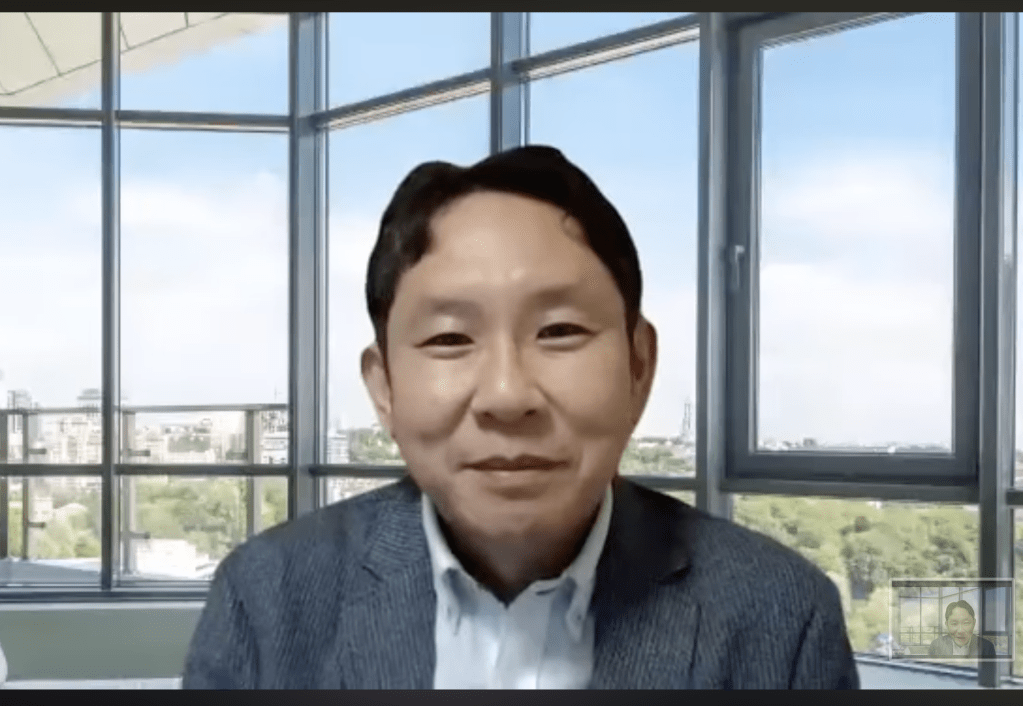
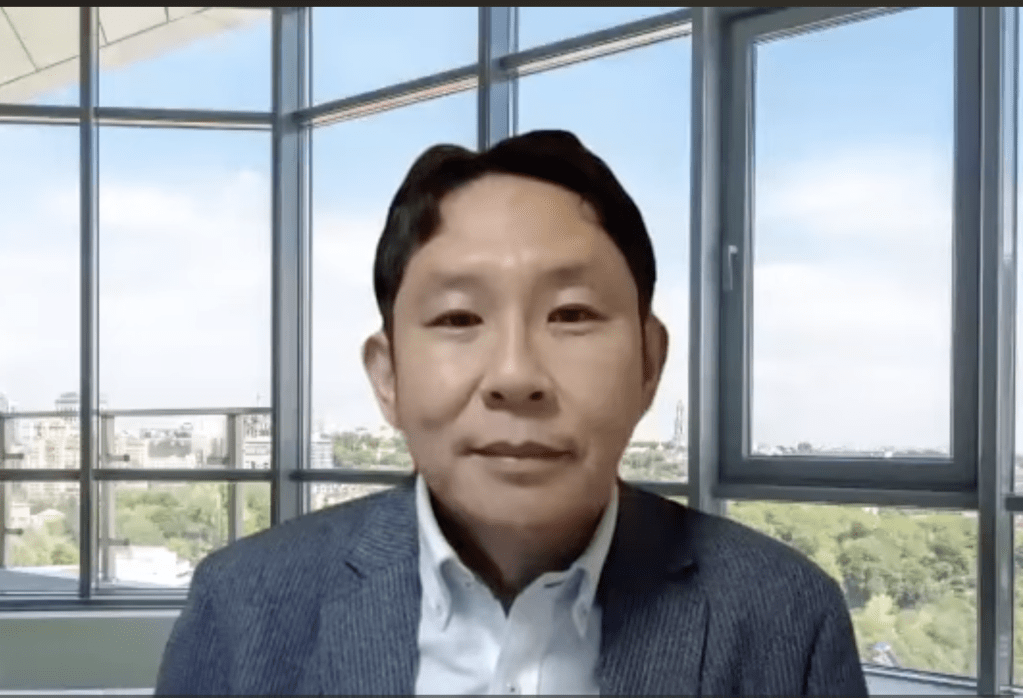
Photos 1〜3: Prof. Chijiwa during his interview with The Japan Lens (April 2026).
No artificial intelligence or machine translation programs were used in the creation of this post.