Audio recap of this week’s top Japan stories:
Synopsis:
- Despite calls from within his party to “take responsibility” for poor election results, the PM is digging in.
- Ishiba’s so-called trade agreement with the U.S. is ambiguous and subject to change at a moment’s notice.
- There is much speculation about what kind of statement Ishiba might release on 80th anniversary of the end of WWII.
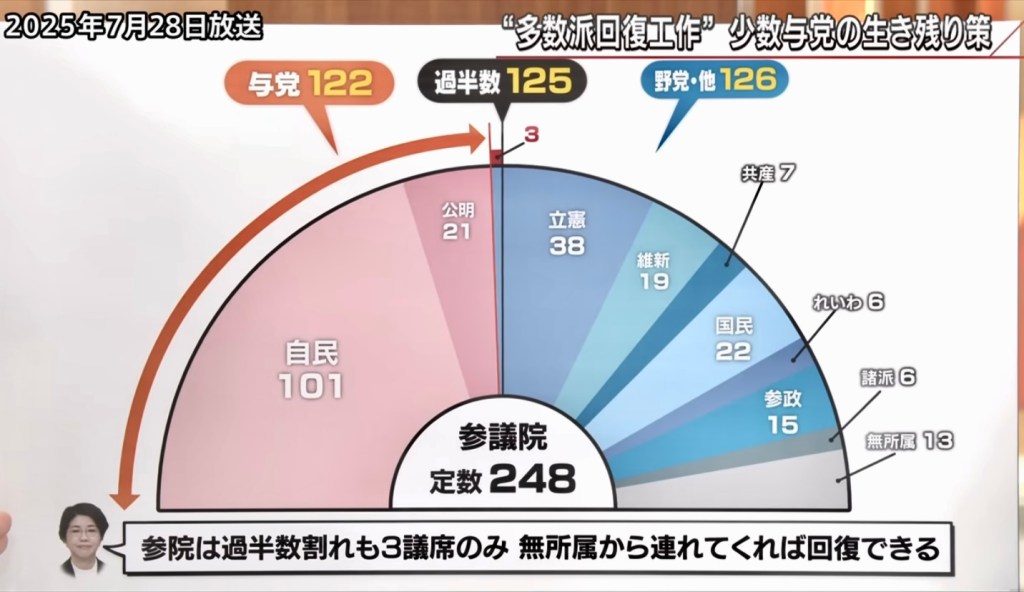
Last month, July 2025, was a hard month for Prime Minister Ishiba Shigeru’s Liberal Democratic Party (LDP), which suffered a major defeat in the Upper House elections held on July 20. As seen in the below graphic from the news show Hōdō 1930, the LDP and its coalition partner, Kōmeitō, won a total of 122 seats, three less than needed to control the house. It was yet another defeat, yet another sign of voter dissatisfaction with the LDP that has been simmering for years now.
It certainly didn’t help that Ishiba’s tariff negotiator, Akazawa Ryōsei, wasn’t able to secure a deal from his U.S. counterpart, Treasury Secretary Scott Bessent. Not in time for it to help in the election, at least. It is likely the Trump administration deliberately waited until after the election; Ishiba needed a win, and Trump denied him that. That means it is probably safe to assume the two leaders do not enjoy a quid pro quo-style relationship, such as the one the U.S. president had with the late Abe Shinzō.
In any case, a trade deal was finally struck at the 11th-hour lowering tariffs on Japanese imports from 25% to 15%. Some details of the deal were made clear, such as a Japanese pledge to buy more American airplanes and $8 billion in U.S. agricultural products, as reported by Ken Moriyasu at Nikkei Asia.
Another key deliverable in the agreement was a pledge from Japan to invest $550 billion in U.S. industries. Now, the “wow factor” of this figure aside, there are a lot of unanswered questions about the details, as outlined by Francis Tang in The Japan Times. For example, it is unknown how Japan will actually make the investments, or if Trump will actually honor the agreement. Notably, as discussed by former USTR official Michael Beeman, a formal written agreement has not been finalized. Also, the Trump administration said Japan’s performance or fidelity will be evaluated on a quarterly basis, which means Trump could decide to undo the agreement at any time. There is precedence for this: Trump slapped these tariffs on Japan despite the bilateral agreement he forced them to sign in 2019, the U.S.-Japan Trade Agreement.
So that’s some context based on developments late last month, July 2025. Now let’s take a look at some specific stories from the past week.
29 July 2025 (Tuesday)
This was a week that started with Prime Minister Ishiba apologizing at the LDP headquarters for his party’s defeat in the elections. As reported by Reuters, Motegi Toshimitsu, an ambitious LDP lawmaker who himself wants to be prime minister, has called for Ishiba to step down. Despite this, and Ishiba’s Japanese-style mea culpa, Ishiba expressed his intent to stay on as prime minister.
Incidentally, Japan watchers may remember that in late 2024 after Ishiba took office he was faced with the choice of cracking down on members of his party for a slush fund scandal or smoothing it over and moving on. He chose smoothing it over. It is important to note the leniency Ishiba showed those scandal-plagued members – most of them from the right-leaning, revisionist Abe faction – doesn’t seem to have bought him any goodwill with them. In fact, those right-leaning members have been especially vocal in calling for Ishiba to “take responsibility” for the Upper House election loss and step down.
Looking back, Ishiba is probably regretting his leniency. He took office with strong support from the public but weak support within his own party. The public very much wanted to see Ishiba clean up the LDP and crack down on those lawmakers involved in the slush fund scandal. Ironically, Ishiba weakened his one strong suit – support from the general voting public – by going easy on these very same Abe faction leaders. But, as reported by Eric Johnston of The Japan Times, Ishiba is showing no signs of stepping down, and, in fact, his administration is preparing its next steps.
30 – 31 July 2025 (Wednesday, Thursday)
In the political section of the Sankei Shimbun there was a story about the first meeting of a committee at LDP headquarters in Nagatachō. This committee, chaired by LDP Secretary-General and Ishiba confidant Moriyama Hiroshi, has been tasked with studying the exact causes of the party’s defeat in last month’s election. A report will be issued in the next couple weeks that will outline what the committee found, to figure out why the LDP performed so badly.
Rumor has it that Moriyama will fall on his sword and take responsibility after the report is released, thereby making it possible for Ishiba to stay on as prime minister. Some observers have commented that the idea any one member of a party can be responsible for how an entire election turns out seems a bit silly. And the calls from within the party – usually expressed in Japanese as sekinin wo totte hoshii, or in English “we want him to take responsibility” – evokes images of a warlord’s vassal committing seppuku, ritual suicide, in order to save his lord. While all that makes for great television on hit shows like Shōgun, many doubt it is an effective way to get down to root causes and conditions, as to why people have soured on the LDP so profoundly. Critics are saying the LDP should be focusing less on ritualized penance and more on gaining the true support of voters.
But what if the clamoring within his party increases? What if Motegi or the former Abe faction right-wingers keep pressuring Ishiba loudly to step down? They can do that, and there is even a movement now within the LDP to collect signatures demanding his resignation. But short of a successful “no confidence” vote in the Diet, Ishiba’s enemies within his party don’t really have a way of getting rid of him. He decides when he steps down, not them. They can make his life difficult, but they can’t really force him out.
Also, many in the LDP are conscious of the uncertainty surrounding trade negotiations with the Trump administration. Those people think that – no matter how unpopular the coach – it’s a bad idea to switch coaches in the middle of such an important game. So Ishiba’s strategy here might hinge on three actions in the short-, medium-, and long-term:
(1) In the short-term, take some of the heat off by letting Moriyama “take responsibility” for the poor LDP election results;
(2) Then get some kind of traction with the Trump administration and formalize an agreement in writing, thereby getting Ishiba a bump in his approval numbers (even though some believe it might be better to leave the agreement vague); and
(3) In the long-term, perhaps shore up long-term support by building a coalition with another party, such as Ishin no Kai.
What do we know about Ishin? Well, it appeals to voters by pushing a platform of, among other things, making education free and lowering taxes. Ishin entered the political scene with a bang a few years back, starting in Japan’s second biggest city, Osaka. Now, Ishin has flatly denied there are any discussions about forming a coalition government with the LDP; indeed doing so might alienate some of their support base. But there are rumors that Ishin’s leaders might be considering some sort of collaboration with Ishiba in order to realize the dream of making Osaka the second capital of Japan (like in other countries, for example, the Netherlands, where one city is the main capital and another is the administrative capital). If Ishiba were to pledge to make that happen, perhaps some sort of alliance with Ishin would be conceivable, albeit extremely difficult.
Would all this be enough to save Ishiba’s premiership? Recent polls have actually shown heartening results for the embattled prime minister. It depends on which polls you read but it seems at least half of voters don’t blame Ishiba for the LDP’s shortcomings. Voters seem to be saying, “It’s the party, not Ishiba.” That would lend credence to the idea that the LDP doesn’t need seppuku of high-profile individuals, it needs real reform. Voters also seem to want Ishiba to stay on and work with opposition parties.
Polls also show one of Ishiba’s enemies – the hawkish, revisionist former Abe protégé, Takaichi Sanae – as one possible contender for the crown if Ishiba were to fall. The appeal in today’s Japan of right-leaning and even far-right parties, such as Sanseitō, which garnered wins with its populist “Japan First” platform, cannot be denied. It’s a new reality in the post-LDP dominant world.
In other news, the Nikkei Shimbun also reported last week there is going to be a reorg shuffle at MoFA, the Japanese Ministry of Foreign Affairs. This is just a side note but actually quite a notable development: economic security – a catchall term for protecting Japan’s economy from Chinese encroachment – will now be one of the key missions of the MoFA economics division. That means Japan’s diplomats will now be weighing in on portions of defense policy, which used to be primarily the area of the Ministry of Defense.
1 Aug. 2025 (Friday)
Another topic in the news these days is speculation over what kind, if any, statement Ishiba will make in the next month or so on the 80th anniversary of Japan’s defeat in World War II. One editorial in the magazine President Online outlined the issues at hand. In the past, Japanese ministers and prime ministers have released statements at key anniversaries about Japan’s role in perpetuating the 2nd World War. In 1993, the Kōno Statement clarified the Japanese Imperial Army’s role in securing the so-called comfort women as sex slaves. In 2015, the Abe Statement recognized Japan’s fault in invading neighboring countries, but rejected the idea that future Japanese generations should keep apologizing for something that happened so long ago.
So, Japanese media is currently hot with speculation about what kind of statement Ishiba might release. Will he apologize for Japan’s past militarism, thereby worsening his standing with conservatives? One rumor has it that Ishiba was furious at demands by right-wingers that he make no statement, the same right-wingers he went easy on early on in his premiership. Ishiba is no revisionist, but he also does not seem to be morally troubled by policy decisions guided by realpolitik. He is conscious of calls to shore up the right spectrum of the party, which seems to be abandoning the LDP for parties like Sanseitō. But he is also conscious of the conciliatory statements about the war made by the Emperor.
Over the next few weeks people will be watching carefully to see if he will indeed press on – with an “iron will” as he has told friends and confidants – and to see if he will release a statement. And if he does, will it be on Aug. 15 or Sept. 2, the actual official date of Japan’s surrender? Ishiba has written and said many times he thinks the end of the war resulted in a hugely unfair relationship between his country and the U.S. In light of all these factors, he is probably contemplating deeply what, if anything, he should say during this solemn anniversary.
– – –
Photo 1: Headquarters of the Liberal Democratic Party (LDP) in Tokyo.
Photo 2: Graphic from Hōdō 1930 news show showing
No artificial intelligence or machine translation programs were used in the creation of this post.