Audio recap of this week’s top Japan stories:
Synopsis:
- PM Ishiba’s party suffered big losses in the Tokyo assembly elections
- More LDP losses in this month’s elections could be “three strikes” for Ishiba
- Populist Sanseitō Party uses social media to gain broader appeal
- Trump increasing pressure on Ishiba over painful tariffs
24 June 2025 (Tuesday)
Prime Minister Ishiba Shigeru returned from his overseas summits and meetings just in time for the Tokyo Metropolitan assembly election, which took place on June 22. The results were not good for him. Ishiba’s center-right Liberal Democratic Party (LDP) suffered a major setback in this election, which was widely viewed as a bellwether of what is to come. One big winner was the Tomin First no Kai, or “Tokyoites First” party, backed by the conservative governor of Tokyo, Koike Yuriko. In 2017, Koike left the LDP to form the Tokyoites First party and has garnered a reputation as something of a right-leaning hawk.
There were 30 LDP members holding seats in the Tokyo assembly, but in this latest election that number dropped by almost a third to 21. It was a stunning loss for the prime minister’s party. The conservative Sankei Shimbun ran a piece titled “Losses in Lower House and Tokyo Elections: Losing the Upper House election will be his third strike.” The gist of the article was as follows: since taking office the formerly popular Ishiba has failed to serve as an effective leader or face of the party. He is purportedly so unpopular that during campaigning for the Tokyo assembly elections he had to keep a low profile so as to not hurt the chances of LDP candidates. Meanwhile, his rivals vying for the premiership – including the hawkish Takaichi Sanae and the ambitious Motegi Toshimitsu – aggressively stumped for candidates.
The Upper House election scheduled for 20 July is now viewed as a do-or-die moment for Ishiba. One veteran LDP lawmaker quoted in the Sankei article pointed out how Ishiba has failed to rally support for his party in two big elections, those for the Lower House and the Tokyo assembly.
“The party lost those elections, so that’s two strikes against Ishiba. If he can’t get results in July’s Upper House elections, that’ll be three strikes. And he’ll be out.”1
Anonymous LDP lawmaker
Such interpretations are the norm, especially in Japan where there is a tendency to place responsibility for macro-scale phenomena on one person. However, the trend of a sudden and quick drop in a prime minister’s popularity soon after taking office is something that has plagued every LDP prime minister in recent years, at the very least since Abe Shinzō’s last term. That would seem to indicate a broader trend bigger than any one administration, where the electorate has soured on the LDP and is actively looking for viable alternatives, such as the previously mentioned Tokyoites First party.
25 June 2025 (Wednesday)
There was also some defense-related news. U.S. President Donald Trump visited the Hague and, in a surprise turn, seemed to successfully push most of the members of the North Atlantic Treaty Organization (NATO) to raise their defense spending to 5% of GDP, with an eye on putting a check on Vladimir Putin’s Russia. This development would have seemed unlikely even just a few months ago, when Trump routinely criticized NATO and made comments that almost seemed as if he was taking Russia’s side.
Also, given how the Ishiba administration rebuked the U.S. for its pressure on Tokyo to raise defense spending to 3.5%, this NATO development could be bad for Japan. However, the Mainichi Shimbun ran an article titled “Open to Each Country’s Interpretation? The ambiguity remaining in the 5% agreement for NATO spending.” Part of the context here is that the Trump administration has gained a reputation – rightfully or not – for avoiding the devil in the details, choosing instead to prioritize headline-grabbing wins. If the increase to 5% ends up being pro forma for some members, then that might alleviate some of the pressure on U.S. allies like Japan and South Korea.
26 June 2025 (Thursday)
Meanwhile, tariff diplomacy between the Trump administration and Ishiba’s trusted economic revitalization minister, Akazawa Ryōsei, continues. The minister departed last Thursday to Washington, D.C. for the seventh round of talks.
NHK News ran a story with the headline: “Min. Akazawa Departs for the U.S., ‘Aiming for a Package Deal.’” The term “package deal” here refers to a bilateral trade agreement on multiple items, not just Japanese cars which are what concern Tokyo the most. Trump has preferred one-on-one trade deals over multilateral deals which, until relatively recently, were the global trend. (The perception in recent years that free trade has only served the interests of elites has helped fuel a global populist movement. It is possible that such dynamics are also on the rise in Japan, as seen by voters turning to alternative parties such as Tokyoites First and the Sanseitō Party, a right-wing party luring hawks away from the LDP.)
With regard to the U.S.-Japan talks, there have been hopes for some kind of breakthrough by Sept. 1, Labor Day, as reported by The Japan Times.

But the Trump administration might be feeling bullish after a series of wins various fields – NATO raising defense spending, the Supreme Court ruling in Trump’s favor, China agreeing in principle to allowing more rare-earth shipments. In short, Trump officials might be in no hurry to negotiate.
In fact, they might be feeling emboldened to make more demands. Around the time Akazawa returned from Washington empty-handed, Trump put pressure on Japan, saying, “They won’t take our rice, and yet they have a massive rice shortage.” Setting aside the veracity of that statement for a moment, Trump officials know that the rice farming industry in Japan is practically sacrosanct. And it is the case that, for Ishiba’s party, protecting domestic rice farmers is a top priority. As reported by Bloomberg Japan on 1 July in an article with the headline, “Ishiba Administration Struggles to Respond to President Trump’s Comment,” Chief Cabinet Secretary Hayashi Yoshimasa indicated Ishiba had no intention of sacrificing Japan’s agricultural interests. Japanese officials have, for now, studiously avoided directly responding to Trump’s comments. But they are certainly aware of the ticking clock; the deadline for a deal is July 9, after which Trump has said he will raise tariffs on Japanese cars from 10% to 25%.
30 June 2025 (Monday)
In more election-related news, it seems Japanese voters are turning more toward unconventional parties. The Nikkei Shimbun ran an article on Monday with the headline “Support for the Sanseitō Party Expands for the Upper House Elections.” The Sanseitō Party, which was founded in 2020 and features what some call an anti-immigrant platform, has made remarkable strides in gaining the support of voters.
As reported in a recent article in the Mainichi Shimbun, parties like Sanseitō as well as the Conservative Party of Japan (CPJ) are now having a moment as they tap into popular discontent and concerns over foreigners in Japan.
That discontent has been epitomized by several high-profile cases of non-Japanese acting in outrageous ways in public or in Japan’s sacred spaces, or stories of trouble arising between foreign laborers and Japanese authorities. Voters are increasingly writing off government officials, who seem hopelessly out of touch when talking about the need for more foreign labor.
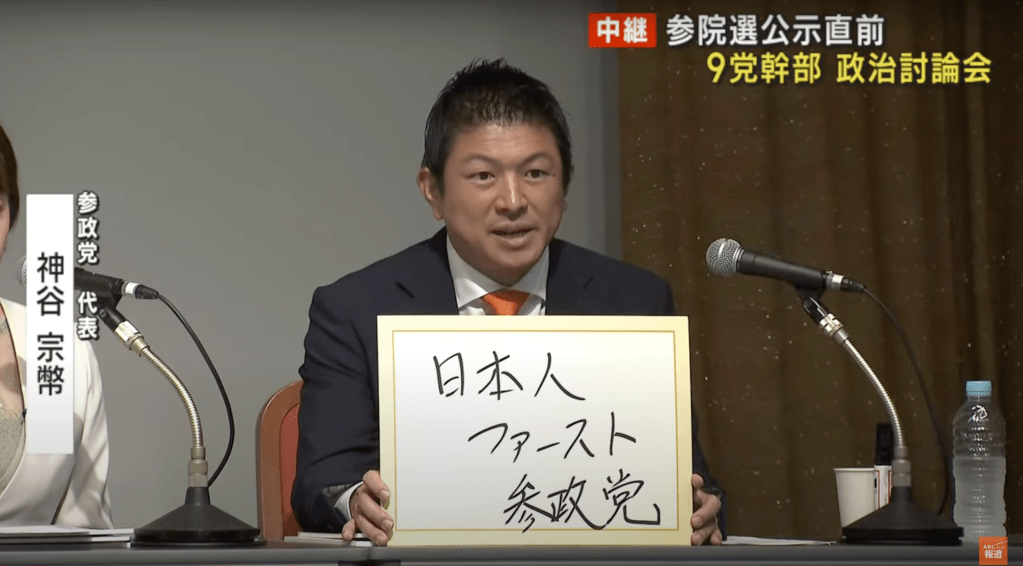
In a recent videotaped forum in Osaka, Sanseitō leader Kamiya Sōhei was seen holding up a sign for his party saying “Japanese First,” a message that has tones similar to that of other populist parties. The Asahi Shimbun has published a story saying more and more ordinary Japanese think foreigners are “scary.”
“Crimes by foreigners are on the rise and it’s making our citizens uneasy.”2
Kamiya Sōhei
Kamiya also blamed foreigners for other societal ills, such as depressed wages and economic exploitation. This was formerly the stuff of fringe parties.
How well are these right-wing parties likely to do? The Nikkei article says Sanseitō might place third as it quickly gains on Ishiba’s ruling LDP and former Prime Minister Noda Yoshihiko’s Constitutional Democratic Party (CDP), which has focused its campaigns on cost of living issues. A Kyodo News survey of voters shows Sanseitō coming in fourth after the Democratic Party for the People (DPP).
Regardless, it is a stunning rise for a party that didn’t even exist until a few years ago. Sanseitō is known for getting its message out to voters via social media platforms like YouTube, another hallmark of populism. The trends seem to indicate that more and more Japanese are turning to social media and abandoning mainstream news sources.
– – –
1Nagai, Daisuke. 2025. “Losses in Lower House and Tokyo Elections: Losing the Upper House election will be his third strike” (参院選負ければ3アウト). Sankei Shimbun. 24 June 2025. 「参院自民ベテランは「衆院選、都議選で『石破効果』はなくツーアウト。参院選で結果を残せなければスリーアウト、チェンジだ」と。
2Kamiya, Sōhei. 2025. “Upper House Debate with Nine Party Heads” (9党幹、政治討論会、参院選). Osaka debate on 29 June 2025. At 28:52 mark: 「外国人の犯罪も増えまして国民が不安を感じている。」
Photo 1: A jubilant Tokyo Governor Koike Yuriko winning reelection in July 2024 (Asahi Shimbun).
Photo 2: Graphic from story on Trump diplomacy at recent NATO Summit (CNN).
Photo 3: Screen shot of Kamiya Sōhei holding a sign saying “Japanese First” on a video dated 29 June 2025. Kamiya was participating in a political debate for the July 2025 Upper House elections.
No artificial intelligence or machine translation programs were used in the creation of this post.