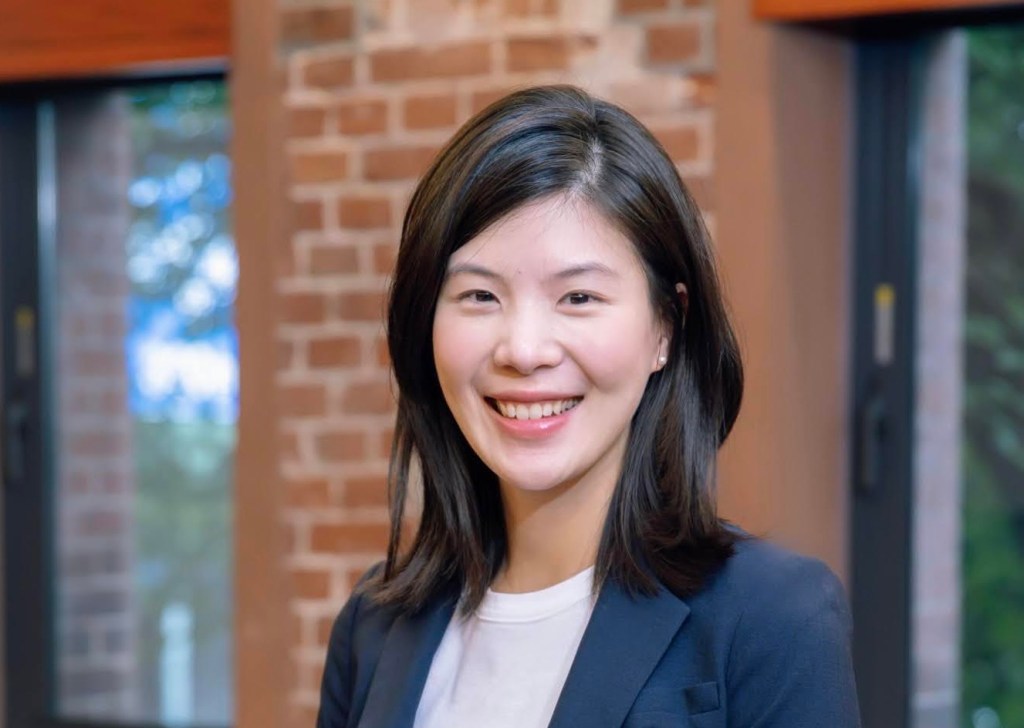
Interview with Prof. Emily Chen of Tokyo University. Some key takeaways from our discussion:
- Japan’s foreign policy is guided by values, but it calibrates how hard it pushes them based on costs to its security
- Japan has a real opportunity to fill the regional void left by the U.S.
- But in declining to criticize the U.S. for unilateral actions, Japan risks losing credibility in Southeast Asia and the Global South
- On A.I. Japan is somewhere between the U.S. and EU, calling for a soft governing approach
(Click here for a summary in Japanese.)
Emily Chen Bio
Emily S. Chen is a Project Assistant Professor at the Institute for Future Initiatives at the University of Tokyo, and a Visiting Fellow at the Dentsu Soken Center for Economic Security Research (DCER).
Her research examines how states translate norms and values into foreign policy and pursue values-based international cooperation amid geopolitical competition. It centers on Japan and other democratic middle powers in the Indo-Pacific, with particular attention to issues such as democracy promotion and human rights, technology governance, and security cooperation. Prof. Chen also maintains a broader interest in Indo-Pacific international relations, especially U.S.–Taiwan–China relations and great power dynamics.
She has previously held research positions at the Brookings Institution, the Center for Strategic and International Studies (CSIS), and the Stimson Center, as well as fellowships at Pacific Forum, the Hoover Institution, and the Center for the National Interest. As for her schooling, Prof. Chen received her B.A. from National Chengchi University in Taiwan, where she majored in international relations. At Stanford University she got her M.A. in East Asian Studies, and she earned her Ph.D. from the University of Tokyo.
Below is a transcript of our interview edited for length and clarity.
– – –
(Kafatos): Could you tell our viewers about your background, and how you came to research Japanese foreign policy?
(Chen): I am from Taiwan, born and raised, and did all my schooling through college there. I majored in international relations, then I went to the U.S. for a master’s degree in East Asian studies. I spent a few years in Washington, D.C. working at think tanks, and eventually came to Tokyo for my PhD.
As for why I moved to Japan, that was really a few things coming together. When I was in D.C. around 2014 I noticed the policy world was incredibly crowded with China experts. I trained and aspired to be one myself, but I felt there was a real gap because not enough people were studying Japan in depth from a policy angle. I was always interested in that, especially since I majored in international relations in the Asia-Pacific, which nowadays the buzzword is Indo-Pacific. And, more personally, I have family in Japan so it made sense on that level, too. Also, being from Taiwan I naturally gravitated toward questions where Taiwan and Japan overlap and cooperate.
In the end, my research question focused on this: “What happens when values meet reality in foreign policy?” In other words, why do democracies like Japan talk about values, but act on them so unevenly? That’s really the core of my research agenda.
(Kafatos): There was a recent op-ed in The Economist saying Asian allies are “doomed to hug the Trump administration close.” The article said Japanese foreign policy vis-à-vis the U.S. is guided by realpolitik, while European policy is too naïve or idealistic. But others say the U.S. is no longer reliable, pointing to recently scaled back exercises with South Korea. What is your thinking on Japan’s approach to U.S. foreign policy?
(Chen): First, about so-called Japanese pragmatism and European naiveté, I would like to push back gently on framing the issue this way. It sets up a contrast that I don’t think holds up once you look at it closely. There is a version of this argument that’s genuinely strong, and I want to take it seriously; it’s Japan’s dependence on the U.S., which is really profound. Japan has no independent nuclear deterrent, and Japan would struggle to manage a Taiwan contingency or North Korea crisis without U.S. support. Given that, I think Japan has to weigh its public criticism of U.S. policy more carefully than a distant European government does. That asymmetry is real and quite obvious.
Where I think the piece overreaches is when it implies Japan’s silence is realpolitik. It makes it sound like Japan is calmly signing off on controversial U.S. actions, but I don’t think that’s what’s going on. What I actually see is closer to what I call a “normative floor” that Japan is holding. Japan is not, for example, celebrating the U.S. operations against Maduro in Venezuela or the Iran strikes the way the op-ed implies allies should. But it’s also not condemning them directly. Japan is staying in a quite narrow, ambiguous middle, and that ambiguity serves a real purpose. It lets Japan avoid friction with Washington without actually putting its name behind actions it may have real discomfort with.
“If you’re Japan you don’t just out-argue unpredictability. You build up your resilience to it.”
-Emily Chen, on how Japan deals with an increasingly unpredictable U.S.
Honestly, I don’t have visibility into what’s being said inside Japan’s Ministry of Foreign Affairs (MoFA) on these recent episodes involving U.S. foreign policy. But the pattern fits what I’ve found across other cases, which is Japan has a values-based identity, and it calibrates how robustly it acts on that identity based on cost.
I wouldn’t call it hypocrisy on Japan’s part, just like I wouldn’t call it naivete on Europe’s part either. It’s just a much less satisfying story than “Asian realists versus European idealists,” because both Japan and Europe are doing the same basic thing: managing their exposure to risk. And the reality is, they just have very different amounts of it.
As for the U.S. scaling back exercises to court North Korea, I want to separate two things here because I think it’s easy to conflate them. Reducing a joint exercise isn’t unprecedented. Presidents have scaled back drills before to support diplomacy with North Korea. That is part of normal presidential discretion, and reducing exercises in and of itself is not alarming.
The part that was concerning to capitals like Tokyo was the logic behind it. This wasn’t framed as part of a coordinated diplomatic strategy with South Korea. Instead it seemed to be about personal rapport with King Jong-un. Additionally, it was tied to Trump’s frustration with South Korea for not helping out with Iran, which is an entirely separate issue that caught Seoul off guard.
That combination – a security commitment adjusted unilaterally based on personal chemistry with an adversary, and leverage within an unrelated dispute – is exactly the pattern Japan has been quietly worrying about. It’s the same worrisome logic behind U.S. arms sales to Taiwan being described as a possible bargaining chip, which happened earlier this year. America’s security commitment starts to look conditional on the president’s mood rather than an institutional obligation.

So what does Japan? I don’t think the answer is public pushback on U.S. behavior, that’s not really an option for a treaty ally.
The same goes for South Korea; Seoul’s response was to say the drills would proceed as scheduled before ultimately accepting the reductions. That shows how limited their leverage is, too.
In light of all this, Japan has been quietly building its own capability to reduce its dependence on Washington’s day-to-day disposition. They also need to deepen ties with multiple partners, and diversify their partnerships through initiatives such as the Quad and trilateral diplomacy with other middle powers. If you’re a country like Japan or Korea, no single relationship can define your security position. I think Japan is adjusting to this new reality.
So, it’s not a dramatic answer, but it is a realistic one. If you’re Japan you don’t just out-argue unpredictability. You build up your resilience to it.
“There are three forces that determine the direction of Japanese foreign policy.”
-Emily Chen, on Japan’s values, identity, and pragmatism
(Kafatos): Turning now to your research, do you think Japanese foreign policy is guided by a moral compass? Or do you think it tends to skew more pragmatic? Or does it depend?
(Chen): Okay, so if my answer is, “It depends on the issue,” that doesn’t seem like a very satisfying answer, right? But… It depends on the issue! (Laughs)
Actually, I want to be very careful with that answer because it can sound like a dodge, but it’s not. The variations we see in Japanese foreign policy are not random, there’s a structure to it. At least, that is how I see it from my research, which shows there are three forces that determine the direction of foreign policy.
The first is beliefs. Japanese policymakers, especially younger diplomats, tend to have liberal democratic values. I’ve seen it in my interviews as well as my diplomat surveys, which were anonymous so there was a need for them to lie.
The second force is identity. Policymakers understand and perceive Japan as being a democracy, one with a responsibility to model good behavior in the 21st century. They no longer view their democracy like it was in the post-war era, one which was imposed upon Japan by the U.S. From my interviews I saw that many policymakers believe Japan earned the democracy it has today after decades of trial and error. It’s not perfect, but it is an established and mature democracy with a responsibility to act on its values.
And the third is quite obvious, pragmatic calculation, meaning Japanese policymakers need to think about alliance management and economic exposure, especially with China.
When these three forces interact, the result is a pattern that looks inconsistent from the outside, but it isn’t. For example, Japan shows restraint toward Myanmar, but takes a very hard line on the North Korea abduction issue. And when its own wartime record gets challenged internationally – especially by China and South Korea – it becomes sort of defensive. These are three completely different postures.
But it’s the same country with the same underlying logic. Basically, there’s a line Japan won’t cross. It won’t openly say something wrong is fine. That means it will not condone human rights abuses, because that would be crossing an unforgivable line. But how far it goes in protesting those abuses depends on the case.
And here’s the point I really want to get across: this isn’t a uniquely Japanese trait. Most democracies operate this way, the U.S. very much included. For decades America has been very selective about democracy promotion. Japan is just an unusually clear case, which is actually what makes it useful to study.
I have been developing a concept in my research called “the norms-guided state.” I use it to describe Japan and, potentially, other democracies. For such nations, values are real for them, and they set a floor on what they won’t do (i.e., on which lines they refuse to cross). But the values don’t determine how they will respond in areas that are above the floor. Those responses are actually shaped by strategic stakes and identity. That is how I view values versus realpolitik in Japanese foreign policy.
Take the example of human rights abuses in Myanmar. Many Western countries say Japan should do more, such as join sanctions. Based on my interviews, I found Japanese diplomats are clear in saying they will not tolerate human rights abuses. However, they say “What we can do – or what we choose to do – might differ from Western countries. We share the same goal, but not necessarily the same methods.”
One policymaker gave me the analogy of the good cop and bad cop. If the West plays the bad cop then Japan can be the good cop, and they work together to resolve the situation. In a way, it’s a division of labor. But another policymaker told me, “Japan is not always the good cop. Don’t expect us to always play that role.” There are no clear guidelines within the Foreign Ministry, and their policies can change depending on the case.
(Kafatos): So how those three forces play out – whether it’s Japan’s liberal values or its identity as a mature democracy, or pragmatic calculation – determines what Japan does?
(Chen): Yes, with the understanding that all three forces exist in each circumstance. No one policy is predicated entirely on Japan’s values, nor entirely on pragmatic calculations. If it were, Japan would just tolerate abuses and violations for the sake of improving relations with the offending country. But even in situations where Japanese foreign policy appears coldly pragmatic, there is still this element of what is right. And the source of that is Japan’s beliefs, to include liberal democratic values and its identity as a democratic country in the 21st century, one that should shoulder some responsibilities.
“That was a direct challenge to leaders like PM Takaichi.”
-Emily Chen, on Canadian PM Carney’s “middle powers” speech at Davos
(Kafatos): Earlier this year Canadian Prime Minister Mark Carney gave a famous speech about a new coalition of middle powers. Meanwhile, Takaichi is championing the rules-based order but also pragmatically sticking close to Trump. In light of this perceived inconsistency, do Japanese diplomats lose credibility on the international stage? And is there tension between liberal diplomats and hawks in the Takaichi administration?
(Chen): Carney’s speech at Davos was unprecedented, for Canada itself and for middle powers. I want to first seriously address the inconsistency – the hypocrisy question – because I think there’s real substance to it, not just diplomatic hand-wringing. Carney’s speech was pretty direct. He said the old rules-based order with NATO and American hegemony has ruptured, and that other powers need to band together rather than negotiate bilaterally with a hegemon from a position of weakness. That was a direct challenge to leaders who keep using “rules-based order” language while just accommodating Washington, leaders like PM Takaichi. She does both of those things. She uses that language while also staying pretty close to Trump. So, yes, there’s a visible gap.
But here is where I would push back on calling it hypocrisy. If you judge Japan against the ideal of a fully normative state – one where a country says what it believes and acts on it consistently – then, sure, it looks hypocritical. But I don’t think that’s the right standard. When you judge Japan against what I call the norms-guided state (where values are real but conditioned by structural exposure to strategic risks), then it looks completely different.
Frankly, Canada isn’t sitting next to a potential flashpoint with a nuclear-armed neighbor, the way Japan is with North Korea or with the situation in the Taiwan Strait. Carney can afford candor about American unreliability in a way that Takaichi structurally cannot. If the U.S.-Japan alliance frays, Japan doesn’t have Canada’s geographic cushion.
That said, I don’t want to let Japan off the hook entirely. A real credibility problem is building. If Japan keeps accepting measures like 15% tariffs from its treaty ally, or keeps tolerating Washington’s ambiguity over whether Taiwan could become a bargaining chip – while presenting itself as a defender of the rules-based order – the inconsistency will be noticed. And especially in Southeast Asia and the Global South, those audiences are watching for consistency, not just capability.
As for whether there is tension inside the government between MoFA and the Takaichi administration, my understanding is there isn’t a visible fight over the direction of foreign policy. And it’s notable that Japan’s MoFA is unusually strong institutionally compared to the foreign ministries of other countries.
But I would hold that lightly. You know, the absence of visible tension isn’t necessarily the same as the absence of tension. They are generally, I think, very good at not airing disagreements in public, so it might just be that we don’t know. So far, on the surface at least, I do not see a visible fight between Japan’s diplomats and the Takaichi administration occurring over the direction of foreign policy.
“Nobody wants a repeat of being consulted last but affected first.”
-Emily Chen, on the danger of Japan being left out of U.S.-China talks
(Kafatos): How do you see Japanese foreign policy evolving in Southeast Asia and in East Asia? What are Japanese diplomats trying to accomplish there? And is the relationship between Japan and Taiwan changing?
(Chen): So let’s break that into parts: China, Taiwan, and then the wider region, because I think Japan’s posture is quite different in each.
First, let’s talk about China, Japan’s biggest neighbor. I think Japan generally welcomes the lowered tensions and managed engagement between Washington and Beijing, but not at the cost of being sidelined on the Taiwan issue. If Beijing and Washington are quietly negotiating some kind of modus vivendi on trade or tech, and Taiwan’s security ends up implicitly being a part of that bargain, then Japan has no seat at that table.
And if we remember the “Nixon Shock” of 1971, when the U.S. opened relations with China without consulting Tokyo, that is still a live reference point in Japanese strategic thinking. Nobody wants a repeat of being consulted last and affected first.
So Japan’s response has been to hedge. It’s not moving towards China, but it’s also not fully embracing the U.S. nor walking away from it. Japan is instead deepening its partnerships in groups like the Quad, expanding its strike capabilities, and strengthening ties with Australia, India, the Philippines, South Korea, and Europe. Japan wants more cards in its hand, not a different table.
As for Taiwan, the bilateral and informal people-to-people relationship has long been warm. But the biggest concern for Japan is what it should and could do if a Taiwan contingency were to occur. That’s an issue a lot of people are watching carefully. Honestly, a Taiwan contingency is functionally Japan’s own contingency, whether they like it or not. The Taiwan Strait is roughly 100 kilometers from Japan’s southwestern islands. Any serious hostilities there would almost certainly involve U.S. bases in Japan.
I think what Japan is trying to do is quietly build real capability, like obtaining counterstrike missiles, while working on its legal architecture and defense agreements. All while keeping its public language deliberately ambiguous, partly for domestic politics but partly to avoid antagonizing Beijing.

As for Southeast Asia and the broader region, I think there is a genuine opening right now, especially with regard to values. The U.S. is pulling back from democracy and human rights promotion in Asia, so there’s a vacuum.
Japan actually has the credibility and relationships to help fill it. I think Japan could be more successful because many of those countries still view the U.S. with suspicion.
But so far, I feel Japan’s rhetoric on democracy and human rights has outpaced its tools. Japan is the only G7 country without Magnitsky-style sanctions, meaning sanctions that target specific individuals responsible for human rights abuses. Whether Takaichi will actually step forward to fill that vacuum is an open question. I wouldn’t want to try to predict either way, but there is an opportunity here for Japan.
(Kafatos): In the past many said Japan’s unresolved wartime issues reduced its effectiveness in the region because countries viewed it with suspicion. But you are saying that’s no longer the case.
(Chen): I think there are two parts to this. The first is, how do Japanese policymakers feel about promoting values in Southeast Asia, given Japan’s war history? There’s always been this argument that Japan is trying to hold back on promoting its values in order to avoid being reminiscent of the past, to avoid making countries feel once again Japan is imposing itself. I actually asked this question in my interviews with senior Japanese policymakers. Some of the answers were really interesting.
They say after the war Japan engaged for decades in reconciliation efforts in Southeast Asia. Most deem these efforts as having been quite successful so, in that sense, policymakers think Japan does not have to worry overly about whether it’s OK to promote values in the region. Japan’s wartime history does not affect whether they will promote their values in the region, but it does affect how they do it.
My own understanding is that it depends on the country. Some countries are communist and thus closer to China. Many of them still try to avoid concepts like democracy and human rights. There have been discussions about the region’s Asian values, but that has yet to become a centralized concept in regional foreign policy. That’s been my observation.
“The U.S. approach to A.I. is more market and innovation-driven, while the EU is more rights-based. Japan is somewhere between the two.”
-Emily Chen, on different countries’ thinking about A.I. governance
(Kafatos): You’re now part of an initiative looking at A.I. governance, and the confluence of diplomacy with science and tech. What will you be really looking at going forward over the next few months in the Indo-Pacific region, or beyond?
(Chen): Right now I am in the middle of a field work trip in Taiwan looking at science and technology diplomacy between Japan and Taiwan. That’s given me a much closer look at how things play out on the ground, especially right now since science and technology diplomacy is a geopolitical and geo-economical issue.
I am also working on extending my research on the norms-guided state framework. I want to extend it beyond Japan into a real comparative test. I’m looking at Canada, South Korea, potentially the UK, Australia, and other democratic middle powers. And asking whether the same logic – values as a floor, calibration above it, all driven by strategic exposure – holds up in countries other than Japan. Or does it need to be rethought? Carney’s Davos speech is a promising start for this framework, but I’ll have to look into it more carefully down the road.
A.I. governance is especially front and center these days. I am currently interested in the verbiage nations use when talking about A.I. governance. For example, when a state uses language like “human-centric A.I.,” does that reflect a real policy commitment? Or are there times it functions more as diplomatic bridging language, something that lets countries with very different regulatory approaches sound aligned when in fact they are not?
This is an area where the rules are still being written. It’s a much harder test of the framework than democracy and human rights diplomacy, where there’s at least an established baseline to measure against. People are thinking about what kind of rules we should have for A.I. Some emphasize transparency while others want a rules-based systems. This field is still very much underdeveloped, so I’m interested in working on it for the next few years.
(Kafatos): With A.I. it feels like the horse burst out of the barn, and now they’re frantically trying to make a road for it to run on. But it’s already running.
(Chen): Yes! And different countries have different regulatory approaches. And what’s interesting is that the global governance landscape on A.I. is not divided by, say, democratic countries versus authoritarian countries. Democratic countries can be quite aligned with authoritarian countries in some aspects, and democratic countries themselves have different views. The U.S. approach to A.I. is more market and innovation-driven, while the EU is more rights-based. Japan is somewhere between the two, espousing a soft governing approach, an approach built on a framework based on principles.
It’s very interesting to see how democratic countries work with each other on A.I. governance, or how they don’t. And how they respond, react, or engage with authoritarian countries on this matter.
(Kafatos): Is the Japan-Taiwan science and technology collaboration you’re looking into only focused on A.I.? Or are there other fields of science and tech, too?
(Chen): There are many fields but currently I am only involved in the A.I. governance part. I’m part of a study group looking at Japanese science and tech diplomacy. We have people studying all sorts of fields, such as A.I., quantum computing, and space. It’s a group of hard scientists but also social scientists, and it’s very interesting research. I’m looking forward to exploring it more.
(Kafatos): It’s so timely and necessary in today’s era. We look forward to seeing how it develops, and we appreciate the nuanced view of Japanese foreign policy you shared with us today.
(Chen): Thank you so much for having me.
– – –
Emily S. Chen is based in Tokyo where she continues her teaching at Tokyo University. For more information on her research, visit ResearchMap. The Japan Lens wholeheartedly thanks her for her valuable time and insights.
Photo 1: Prof. Emily S. Chen.
Photos 2 & 3: Prof. Chen speaking to The Japan Lens (21 Aug. 2026).
No artificial intelligence or machine translation programs were used in the creation of this post.


One response to “Interview with Emily Chen: Japan is a “norms-guided state,” but limiting exposure to risk is paramount”
[…] (インタビューの英語原稿はこちらへ。) […]
LikeLike