Interview with veteran Japan expert Glen S. Fukushima. Some key takeaways:
- The Japanese business community is concerned about worsening China relations, but politicians see little upside to mending fences.
- Debates about Japan possessing nuclear weapons have now entered mainstream discourse.
- Most Japanese officials think the U.S. attack on Iran was likely illegal, but can’t say so openly.
- Japanese companies are still eager to do business in the U.S., despite societal and political issues.
- California is the future of America, not Washington, D.C.
See below for his bio and a transcript, which has been edited for flow and clarity.
Glen S. Fukushima Bio
Glen S. Fukushima, a third-generation American of Japanese ancestry from California, attended college at Deep Springs and Stanford. He did his graduate studies at Harvard and was an exchange student at Keio University, as well as a Fulbright Fellow at Japan’s most prestigious institution of higher learning, the University of Tokyo.
One of the most prolific subject matter experts on Japan, Mr. Fukushima has been engaged in U.S.-Japan relations since the 1970s. He has served in a variety of roles, one of the most notable being Deputy Assistant U.S. Trade Representative for Japan and China at the Office of the U.S. Trade Representative (USTR). He was also elected twice to serve as President of the American Chamber of Commerce in Japan (ACCJ). Since 2022, Mr. Fukushima was tapped by President Joe Biden to serve as Vice Chairman of the Securities Investor Protection Corporation (SIPC). He is also a Distinguished Career Fellow at Stanford University, and a Senior Fellow at the Center for American Progress (CAP).
The Japan Lens sat down with Mr. Fukushima on June 24, 2026 to hear his views on a range of issues in U.S.-Japan relations.
– – –
(Kafatos): You have been making the rounds on various Japanese news shows lately. What types of questions or concerns about the U.S. are you hearing from Japanese?
(Fukushima): I was in Japan until the early part of June. I appeared on a Japanese TV news program, and I also attended several study groups, meetings with Japanese business people, political people, government officials, and so forth. And last week I gave a talk to Japanese business leaders in New York City. There generally seem to be four areas of interest.
The first is directly related to China and Prime Minister Takaichi’s visit to Washington, D.C. on March 19. The original thinking was that President Donald Trump would be going to China at the end of March or early April, so Takaichi’s trip was timed to discuss with him Japan’s views just before he leaves for China. Also, to discuss the comment she made in the Diet last year on November 7 (about Japan defending itself in a Taiwan contingency), which over the past several months has triggered many angry actions from China.
Also, people have wanted to know what was discussed and agreed to between the two leaders when Trump visited Xi in China this past May. But people are also asking about the meeting to take place when President Xi visits Washington in September of 2026. So China, and especially Taiwan, is a whole area of interest.
The second area of interest is security cooperation between the U.S. and Japan. There is a lot of interest in arms purchases by Japan, and also the recent lifting of arms export restrictions. I’ve been having discussions just recently with people in Silicon Valley about the growing interest in Japan in dual-use technology. And I assume that, before too long, there’s going to be discussions about host nation support.
There is also the matter of defense expenditure. The Kishida administration decided to raise it to 2% of GDP, and the Takaichi government has sped up that timeline. Now there is talk from some in the U.S. saying 2% is not enough, that 3.5% or more is more appropriate. So people are very interested in the defense situation.
The third area of interest is the economic side, the $550 million agreement (to be invested by Japan in the U.S.). Tariffs are not so much the focus. The Akazawa meetings in Washington resulted in auto tariffs being lowered from 25% to 15%, and the U.S. rice import quota for minimum access was not changed. So the tariff issue seems to be on the back burner, at least for now.
The fourth issue of interest is the U.S. midterm elections that will take place November 3. They wonder how the midterm elections will turn out, and what impact it could have on the final two years of the Trump administration.
“The results were underwhelming.”
-Glen S. Fukushima, on what Trump achieved at the summit in China
(Kafatos): There has been a lot of summitry lately, what with the Trump-Xi summit in China and the G7 in France. What has stood out for you?
(Fukushima): Regarding the Trump-Xi summit, I think the results were underwhelming. People were expecting some major announcement. Certainly what Trump wanted was expanded economic ties. He wanted China to commit to buying more soybeans and hundreds of Boeing jets; he did get a commitment of 200 jets, but that was fewer than predicted. Trump wanted to show he is on good terms with Xi Jinping, that he’s respected in China, that he was able to get concessions that will benefit the U.S. economically, and benefit U.S. workers, especially with the midterms coming up. He did get a little bit of that, but not as much as expected.
And then on the Chinese side, I think most people were predicting that for Xi the most important long-term strategic issue would be Taiwan, and he wanted to get commitments from Trump on that. Trump appears to have said he will consider the matter of arms exports to Taiwan, which have already been approved by Congress. There is speculation he may cancel, cut back, or delay those – so that is an area of concern. But many are focusing now one what will come from their next meeting scheduled for September 24, shortly before the midterms.
As for the G7, clearly the Iran issue was foremost on everyone’s mind since they all were blindsided by the war. Just recently, the 14-point agreement memorandum was made public, but it seems to indicate the U.S. got much less than what Trump claims. There is considerable criticism from both parties that Trump’s deal gave Iran a lot of money, allowing them to sell oil; and in return the U.S. got a concession that ships can pass through the Strait of Hormuz, but even that is for a 60-day period and it’s not clear what might happen after that.
The G7 is clearly watching the Iran issue with a lot of concern because the economic impact of the Hormuz Strait is significant, especially on Asia.
“Japan does not feel it is in a position to publicly criticize its ally.”
-Glen. S. Fukushima, on why Japan has not denounced the U.S. attack on Iran
(Kafatos): There have been discussions of possibly sending the Japanese Self-Defense Force with minesweeping vessels to the Strait of Hormuz. Takaichi has pushed Japan as a champion of the rules-based order, and has avoided commenting on the legality of the U.S. attack on Iran. Do you get the sense Japan has moral concerns about the attack? Or is their approach more pragmatic?
(Fukushima): There has been a lot of honne (what one really believes) and tatemae (what they want others to think they believe). The honne concern is that the attack could be considered illegal under international law. Some in Japan do agree with many European countries about that. But because they are so dependent on the U.S. politically, militarily, and economically. Japan does not feel it is in a position to publicly criticize its ally.
Also, I think Prime Minister Takaichi wants to be seen as Abe’s protege representing the school of realistic foreign policy. She wants to be seen as closely allied with President Trump and the U.S., and she wants to emphasize there is no daylight between them, in part because of China. But yes, many people in Japan are very aware that Japan could be criticized for cozying up too closely to the United States.
Interestingly, before Takaichi left Japan for the U.S., former Prime Minister Ishiba said on TV, “The first thing the prime minister should do is tell the president this attack on Iran was illegal under international law.” That’s easy for him to say. But, realistically, I don’t think that’s in the cards.
(Kafatos): In the context of security, tensions in the Taiwan Strait seem to be rising. Many believe Japan would almost certainly be drawn into a conflict there. But Trump thinks of the Taiwan issue as a bargaining chip to use against Xi Jinping. In light of this policy change, what would be your advice to defense officials in Japan?
(Fukushima): I am not in a position of advising the Japanese government on defense issues. But I think, as a general principle, it’s always good for Japan and the U.S. to have discussions at multiple levels and forums, and to try to be as closely aligned as possible. Of course at the summit level – prime minister to president – but also at the level of Japanese Diet members and American members of Congress. Also, government officials as well as the business and academic sectors.
Discussions are needed on multiple levels in multiple sectors on all issues, but especially on China. The Chinese are very adept at finding ways to divide and conquer, and to find ways to get the U.S. and Japan to differ on issues. I think the U.S. and Japan need to constantly be in contact with each other, constantly comparing notes and, when appropriate, taking joint actions.
“Some believe a nuclear-armed Japan is a viable option.”
-Glen S. Fukushima, on how Japan today is much more willing to discuss nuclear weapons
(Kafatos): You mentioned the discussion of raising defense spending, not just to 2% of GDP but actually up to 3.5%. Is that really feasible for Japan?
(Fukushima): I’m not sure. Some in Japan would actually be in favor of that, but probably don’t feel they can be out front advocating for such an increase. For them, it can actually be useful to have people like U.S. Under Secretary of Defense Elbridge Colby saying 2% might not be enough, that 3.5% makes more sense.
Now, some people in Japan will say that is just out of the question because, given budgetary constraints, even 2% is a stretch. They are already debating the need for tax increases. So if that were to go up to 3.5%, that would prompt huge discussions about the wisdom and necessity of it. And if they do decide to do it, where will the money come from? What will it be used for?
But others welcome pressure from the U.S. because they can say, “Well, it’s our most important partner and ally. The protector of Japan is saying we really need to increase our capabilities. If we don’t, they may not be as reliable as we would like.” It’s very complicated, not at all a black or white situation where all people in Japan would find such a demand or request unwelcome. Some actually find it to be useful for their own purposes.
The nuclear weapons issue is also a very, very complicated issue. Some believe a nuclear-armed Japan is a viable option. That view is still very much in the minority, but many believe there should be a vigorous debate about it. I think that will be more of an issue of discussion going forward.
(Kafatos): That in itself is incredible. Just a few years ago, when former Prime Minister Abe brought up the need to debate the option, the reaction was a firestorm. Now, it’s a mainstream topic.
(Fukushima): 15 or 20 years ago, Nakagawa (Shoichi), a Diet member from Hokkaido, said he felt Japan should have a discussion or debate about possessing nuclear weapons. Just that elicited a lot of pushback and controversy. In contrast, last fall Japanese news agencies reported that a security official in the Prime Minister’s office said in a supposedly off-the-record meeting with journalists that he personally thought Japan should possess nuclear weapons. But neither the Prime Minister nor the chief Cabinet Secretary criticized or penalized that person. There’s some controversy about that; some people claim the comment was some sort of trial balloon from the administration.
Funny enough, I asked some Japanese senior journalists, “Wasn’t that meeting supposed to be off the record?” And they said, “Well, you have to understand, in Japan there’s on the record, off the record, and kanzen ni (completely and totally) off the record.” And they said the person being interviewed thought he was off the record, but he should have said “this is kanzen ni off the record.” (Laughs) In the U.S. government, my understanding was you could be on the record, on background, and off the record. And “off the record” means you don’t write or talk about it. But not in Japan, apparently. (Laughs)
“There is no incentive for politicians to express an interest in trying to improve relations… There is more to be gained by being tough on China.”
-Glen S. Fukushima, on the state of Sino-Japanese relations and policy in Tokyo
(Kafatos): Some LDP veteran politicians like Nikai Toshihiro thought closer ties with China, primarily through business and commerce, was the most effective way to lower security tensions. But now there is this ice age of sorts between Japan and China, and they say Takaichi’s administration lacks seasoned China hands. How do you see Sino-Japanese relations today?
(Fukushima): Some in the business community are quite concerned. They think her comment about Taiwan on last November caused China to react, such as restricting certain exports of critical materials, also discouraging tourism to Japan, and re-imposing limitations on food imports from Japan.
As for the political community, it used to be that Nikai and Fukuda Yasuo in the LDP and Yamaguchi of the Komeito were all people who had close ties with senior leadership in China. When issues arose they could function as back-channel intermediaries so that, even when things were tense on the government-to-government level, they could smooth things over. Those people are no longer playing that role. Moriyama (Hiroshi) is supposed to be the senior LDP politician – head of the Parliamentarian League between Japan and China – but he apparently is not that active. Hayashi Yoshimasa and Kono Taro were criticized for being too friendly to China, too.
Right now the mood in Japan is so negative about China, there is no incentive for politicians to express an interest in trying to improve relations. Also, Takaichi and many in her orbit believe the LDP won its landslide victory in part because Takaichi took a tough stance towards China. And so the mood now seems to be, at least among politicians, that there’s more to be gained by being tough on China.
The majority of business people I talk to are concerned about the situation. But some have said to me, “Actually, the Chinese are being very pragmatic and practical. They realize Japan is important, especially for the economy, so they are moderating their reactions.” They’re not doing what they did back during the Senkakus controversy, which was boycotting Japanese companies or staging huge protests. These people feel the Chinese have to go through the motions of being angry about the Taiwan comment.
Granted, just the other day two Japanese were detained for allegedly trying to smuggle banned items out of China. Still, the people in the latter school of thought seem to think things are actually under control; and that over time things will get better again.
That said, if it turns out that Xi Jinping and Donald Trump make some kind of deal that Japan feels left out of, then there may be more of a concern that a G2 (Group of Two, i.e., the U.S. and China) is starting to emerge. But at least for now, I don’t sense much alarm in this group about Japan-China relations.
It’s really important for Japan to have constant discussions at every level with U.S. counterparts, to minimize the possibility that China and the U.S. will go their own path and leave Japan in the lurch.
(Kafatos): Speaking of the U.S., what is Japanese business sentiment about the U.S. over the next few years? Are companies hesitant to invest more in the U.S. given three issues that get a lot of news these days: increased political violence, rising income inequality, or the national debt?
(Fukushima): It depends on the products or services the company’s offering. The Japanese market and population are shrinking. Compared to other markets – in Europe, Southeast Asia, Latin America – the U.S. market is still relatively stable, predictable, and growing.
The first issue of political violence, I don’t think that would be a long-term problem, or that it would necessarily affect the ability of Japanese companies to do business in the U.S. And the second issue of income inequality is a long-term problem, but from the standpoint of companies, perhaps not so much. Especially if the product or service is more B2B, business-to-business as opposed to business-to-consumer.
These are real problems for the U.S. economy and society. But from the standpoint of Japanese companies, I don’t know that they affect sales or are huge impediments to doing business. But I do think one of the reasons there is interest in Japan about the U.S. midterm elections, and even beyond that, in the presidential elections of 2028, is because people are wondering: what is going to happen after Trump?
I’ve attended several meetings in where so-called U.S. specialists were saying that even after Trump goes, Trumpism will remain. And if J.D. Vance becomes president these policies will be the new normal. Whereas a few others pointed out how much opposition there is against Trump’s policies; they highlight how Trump has spent so much time on foreign issues and how, contrary to his promises, he has not dealt with inflation. They point out how his tariffs and Iran actions have raised the price of food and gas, and that things are likely to change. If a Democrat becomes president, U.S. policy could change rather dramatically, especially in areas like climate change.
Japanese are watching developments to predict how these will affect the U.S. market for Japanese commercial interests.
(Kafatos): You are also an expert on U.S. politics. Do you think the more expensive groceries and gas are becoming big liabilities for the GOP, regardless of who comes after Trump?
(Fukushima): Public opinion polls certainly show the president’s approval rating is down to 36%, and when it comes to the economy some polls show 26%. His support is split down party lines, so it really depends on independents. They were the ones who thought in the the last election that Trump would do a better job of handling the economy and immigration. Based on that, they voted for Trump over Kamala Harris. Many of them have been disappointed that Trump is spending so much time on Venezuela and Iran and all these other things that don’t really put America first.
On immigration, I think people believe the borders are more under control now than they were under Biden and Harris. But the way deportations are being done has been criticized as excessive.
And then there’s conflict of interest and corruption, problems that are gaining traction. There is increasing evidence the president and his friends and relatives may be taking advantage of information they have, by virtue of being in the government, and making personal gains. That is an issue that some like John Ossoff, the senator from Georgia, has been focusing a lot on, and it seems to be gaining traction. They say one of the reasons Viktor Orban lost in Hungary was due to corruption and conflict of interest. Overall, it looks like support for the GOP is declining.
But there is also the gerrymandering issue. Redistricting is supposed to take place every 10 years. But President Trump asked Governor Abbott of Texas and the Texas state legislature to redistrict, basically, gerrymander so five seats will be in favor of Republicans, and they did that. Gavin Newsom, to counter that in California, put forth Proposition 50 where voters decided to suspend, at least for the time being, the independent commission that does the redistricting. Now five seats in California are tilted in favor of Democrats.
Indiana is a really interesting example because Trump asked the Indiana state legislature to redistrict to favor Republicans, but the Republicans there opposed that. They didn’t do what Trump asked them to do. But in the most recent primaries, 5 of the 7 Republicans who opposed him lost to their opponents who were supported by Trump. So Trump wasn’t successful in getting the Indiana state legislature to gerrymander the way he wanted, but he did get rid of the five state legislators who opposed him.
“I think the House is going to go Democratic majority, although not by the huge margin some thought.”
-Glen S. Fukushima, on the upcoming 2026 midterm elections in the U.S.
And then there’s Virginia. They did what California did, which is to have a proposition under which there were four seats made to be more favorable to Democrats. But then, really unexpectedly, the Virginia State Supreme Court reversed that. Additionally, the federal Supreme Court gutted the Voting Rights Act of 1965, basically saying there is no more discrimination now and so there is no need to ensure blacks have equal representation. That has resulted in Louisiana, Mississippi, Tennessee, and some other southern states to try and gerrymander to reduce the power of the black vote.
So there’s a lot going on, and it’s really difficult to predict what’s going to happen. Before all this gerrymandering many Democrats thought they could win 30 to 40 seats in a blue wave. There is precedence for the opposition doing well in the midterm elections. In 2010, two years after Obama became president, the Democrats lost 63 seats in the House. And in 2018, two years after Trump became president, Republicans lost about 40 seats in the House. So usually Democrats would think a blue wave would give them a bunch of seats in the midterms. But will that be undone by all this Republican gerrymandering? Or will the big disapproval ratings of the president and Republicans be a bigger factor? I think the House is going to go Democratic majority, although not by the huge margin some thought.
Also, until last November I think most felt it would be next to impossible for the Senate to go to Democrats due to big losses in the last election. Jon Tester lost in Montana, Sherrod Brown in Ohio, Bob Casey in Pennsylvania, and then Joe Manchin retired in West Virginia. Those seats went to the Republicans so it’s now 53 to 47. But given the very positive results the Democrats had last November, doing much better than expected, that could change. Some think North Carolina will likely go Democratic with Roy Cooper, the state’s popular governor, running for the Senate.
And then there are five other states: Maine, Ohio, Iowa, Alaska, and Texas. In total there are these six states where it’s difficult to predict what will happen. Some believe it might be possible for Democrats to win four of those six and therefore take the majority back. I personally think the probability of that is still less than 50-50. But, depending on what happens between now and November 3, it is possible.
Most analysts think the House is likely to go Democratic, but not by a huge margin. And they say the Senate’s Democrats may be able to take two or three seats but probably not four. But it’s in flux so, at this point, it’s difficult to predict.
(Kafatos): It feels like the gerrymandering issue is one of several dark stains on the U.S. right now. If a Japanese person points to all this with pessimism, is there a good news story about the U.S. you like to tell them?
(Fukushima): Yes. Last September I accepted a position to be a visiting fellow at Stanford. Since then I’ve been spending more time in the San Francisco Bay Area than in Washington, D.C. Last August I was asked to testify at a hearing of the Select Committee on Trade and Investment with Asia in the California State Assembly. They did not like the confusion and commotion caused by the Trump tariffs. They said to me, “California has benefited from trade, investment, and immigration. Tell us how we can promote trade and investment, especially with Asia.” That, for one, was very refreshing to know.
Number two, San Francisco recently celebrated the 20th annual Sake Day in Japantown. More than 1,000 people came and enjoyed sake from 34 breweries. A lot of these people were just plain Americans who didn’t have anything to do with Japan, but just liked sake. Americans are interested in Japanese products.
Thirdly, the de Young Museum had the “Art of Manga” exhibition. And this was, I think, the largest exhibition on manga ever to date in the United States. They extended it due to popularity. Also, last year there was a documentary, which I supported financially, called Diamond Diplomacy. It’s about the 150-year history of baseball between the U.S. and Japan. It has gotten a lot of positive reviews and attention, especially now with so many Japanese baseball players doing well here in the U.S., including Otani Shohei. So in the areas of sports, food, manga, and trade, these are all things to be positive about here in California.
And then, looking just recently at the election for California governor, Xavier Becerra won in the primaries. He has been in the state assembly, served in Congress in the House of Representatives from California, and he was Attorney General of California. California, being a heavily Democratic state, is likely to choose Becerra to be the next governor. He’s a very pragmatic, realistic guy who values trade and investment. His parents immigrated from Mexico and he seeks a solid immigration policy. All that is very encouraging.
“Look at California, it’s the future. Not Washington, D.C.”
-Glen S. Fukushima, on how California is setting future trends for America
And I often point out that California is the harbinger of the future. I think what happens in California often is what the rest of the country ends up doing. But when I’m in Washington, D.C., I think of Biden and Trump. They differ a lot, especially on issues like climate change, but they’re basically old white men from the East Coast who experienced the Cold War. They focus on Europe as the land from which the U.S. originated.
It’s a totally different environment here in California, where the leaders tend to be younger and don’t have a Cold War mentality. Biden has said things like, “The world is divided into democracies versus autocracies.” I think that’s a pretty unrealistic view. There are a lot of countries out there, including in the Global South, who don’t want to be fully aligned with the U.S. or with China.
Part of this disconnect is generational, but part of it is regional. When I was in D.C. a lot, especially from 2016 onward, it felt like the U.S. was just too focused on the Atlantic, too focused on the past, and on a black and white view of the world. But California has the biggest population at 40 million, and the its economy has surpassed Japan’s. (After the U.S., China, and Germany, California’s GDP is ranked fourth in the world.) It got that way largely as a result of trade, investment, immigration, and investment in education.
Also, California has one of the best public university systems in the country. And many of the entrepreneurs in Silicon Valley came from other countries, so there’s an appreciation of what immigrants can provide. Agriculture in the inner part of the state is a huge source of business, and then there’s Silicon Valley and tech to the north. There’s also biotech in the south, as well as Hollywood and its soft power.
So, yeah, being in California makes me very optimistic. That’s what I tell my Japanese friends. I say, “Look at California, it’s the future. Not Washington, D.C.”
(Kafatos): In trying to predict how things unfold over the next few months, what will you be looking for?
(Fukushima): I’m at Stanford now to write a book about the relationship between Silicon Valley and Japan. To some extent it’s going to be historical, but a lot of it will be focused on the contemporary situation. I’m hoping to finish the interviews and start writing in the fall, to complete next year. That’s my primary concern.
But I will be watching Japan and the Takaichi government and how its future unfolds. With regard to U.S.-Japan relations, I will be watching what’s happening between the U.S. and China. Also, the midterms, after which I expect a number of people will start announcing their candidacy for the presidency. Looking back at 2020, there were 28 candidates among the Democrats alone. I don’t expect there will be that many this time, probably more like ten or 15 Democrats running, and fewer Republicans.
Incidentally, public opinion polls in January of an election year are often wrong. In 1992, I think Bill Clinton ranked only fourth among the Democratic candidates, but he won. And in 2016, Jeb Bush was considered the frontrunner among the Republicans, but he lost. And in 2020, Joe Biden only came in 4th in Iowa, 5th in New Hampshire, and he lost Nevada. It wasn’t until March 2020 that he finally won a primary in South Carolina before going on to win the presidency.
All that is to say, even as late as January of 2028 it might be hard to predict how the presidential election will go.
(Kafatos): We wish you much success in your book writing, and congratulations again on your position at Stanford! Thank you for being with us today.
(Fukushima): Thanks very much, and best of luck with this program.
– – –
More information on Glen S. Fukushima and his many achievements can be found in his bio at the Center for American Progress, his listing on the Securities Investor Protection Corporation (SIPC) website, and on his Wikipedia page. The Japan Lens thanks him for his valuable time and insights.
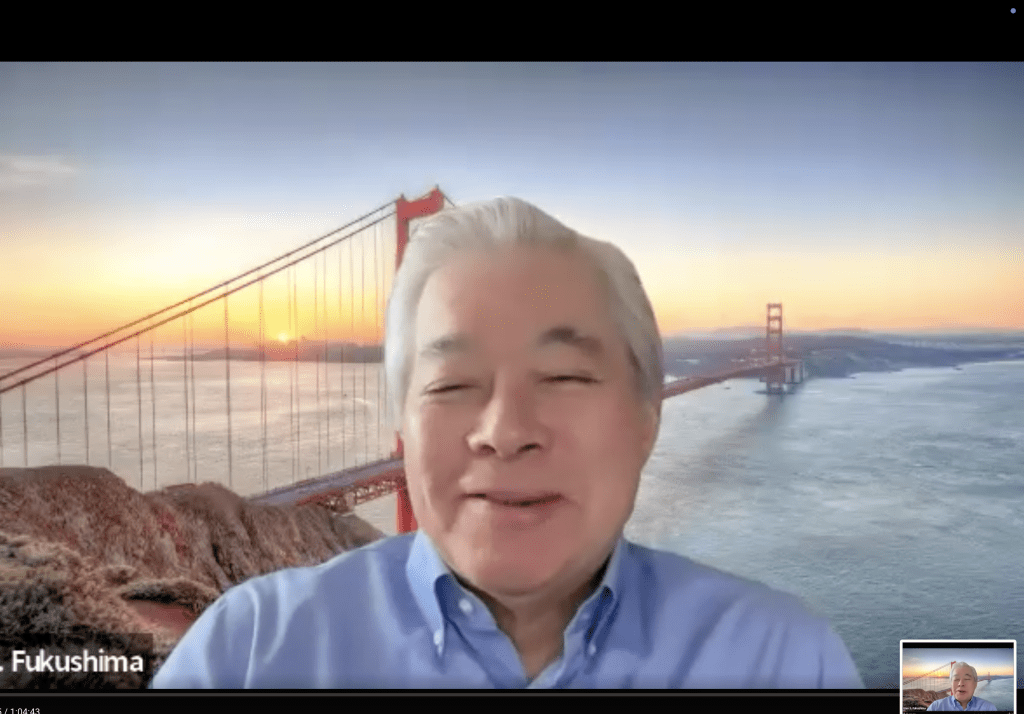
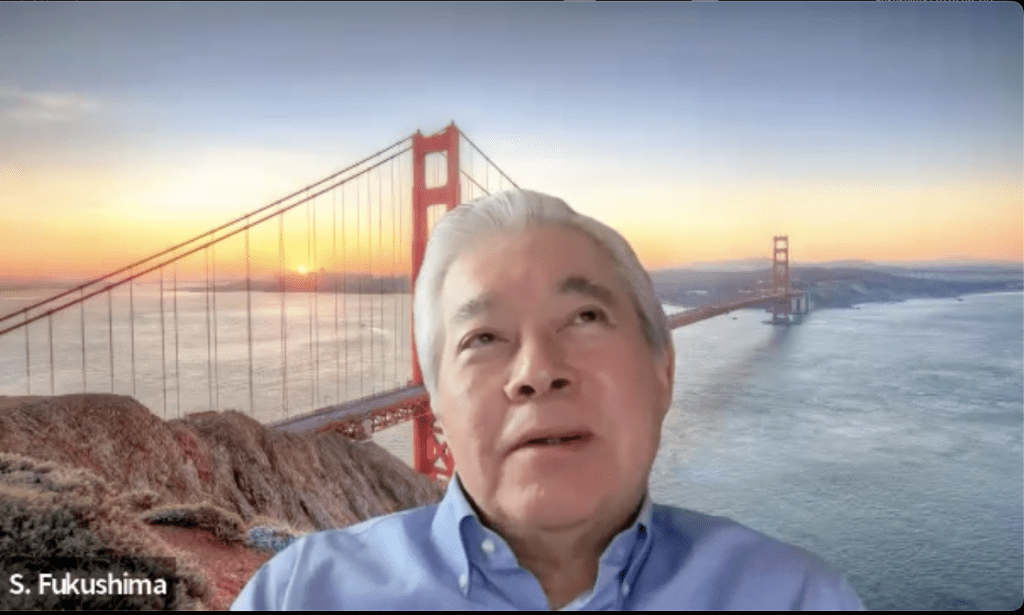
Photos 1 & 2: Glen S. Fukushima during his interview with the Japan Lens on June 24, 2026.
No artificial intelligence or machine translation programs were used in the creation of this post.