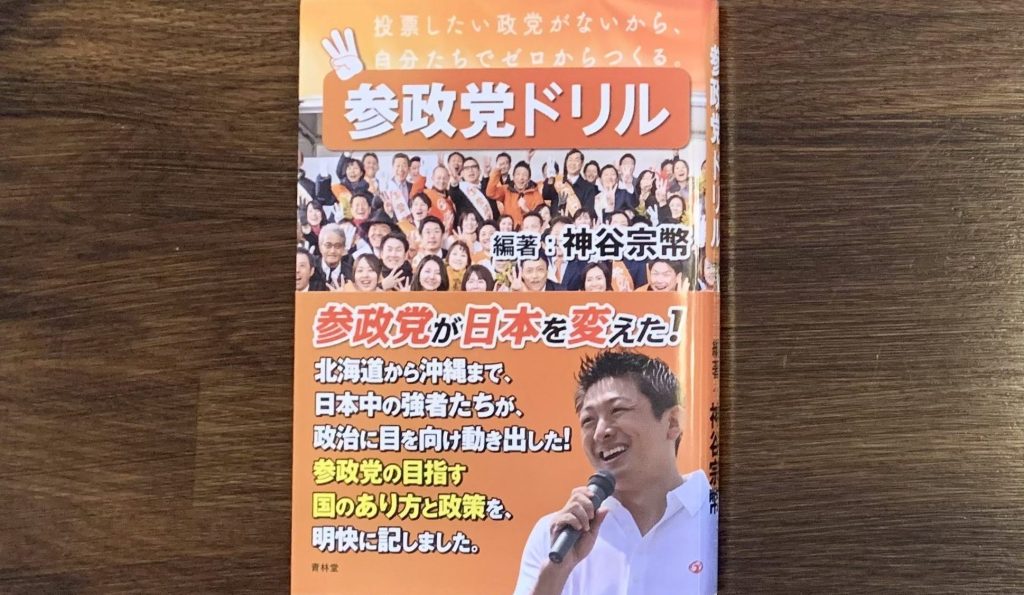
Title: Sanseitō Drills (参政党ドリル)
Author: Kamiya Sōhei
Publisher: Seirindō Publishing
Versions: Softcover in Japanese only (available at booksellers like Kinokuniya and Amazon)
ISBN: 9784792607647
Here are four key themes outlined in Kamiya’s book:
- An elite class of capitalist financiers seeks to undermine Japan’s sovereignty. One example of nefarious activity involves vaccines, which Kamiya characterizes as dangerous products pushed by globalists.
- Various dangers threaten the Japanese people, including corrupt politicians, multinational corporations, dishonest news media, and misguided foreign policy designed to please America. Kamiya calls for a return to Japanese values, including traditional diets and reverence for the Emperor.
- Troops in the Japanese Imperial Army were liberators, not aggressors; American occupiers concocted a fake history in order to subjugate Japan.
- Since the Japanese constitution was written by Americans, it needs to be completely rewritten from scratch, by Japanese for Japanese.
These are just some of the takeaways found in Sanseitō Drills by Kamiya Sōhei, leader of Japan’s right-wing Sanseitō Party. Some characterize Kamiya’s movement as a Japanese version of MAGA. After all, just days before he was killed, the American champion of MAGA causes, Charlie Kirk, met with Kamiya in Tokyo where the two discussed anti-globalist ideas. The comparison holds water in some areas, but not others.
Sanseitō, which means “Political Participation Party,” burst onto Japan’s political scene in 2021, largely thanks to a robust YouTube campaign, where Kamiya’s speeches criticizing the incumbent party gained a lot of viewership. The cover of the book, in its signature orange color, shows supporters holding up the three-fingered sign of the party. (“Three” in Japanese is pronounced san, which is also the first syllable in “Sanseitō.”) The book is written like a test preparation guide, a culmination of Kamiya’s answers to approximately 70 policy questions, which he insists party members have to know. Incidentally, three is also the number of major pillars to Kamiya’s political movement: health, protecting the nation, and education.
Views on health-related issues
One issue where MAGA and Sanseitō seem aligned is deep skepticism of COVID vaccines. Kamiya claims these are being pushed by the World Health Organization (WHO) in a bid to control Japan, and this is one of several sections in which he makes reference to a cabal of shadowy elites with a globalist agenda. At times he writes about how Japan has been exploited and even subjugated, and seems to use historically loaded language, such as from the era of slavery in U.S. history.
“We find ourselves in a situation where… today’s Japan is just an economic plantation for international finance capitalists.”1
Kamiya Sōhei
Despite Kamiya’s affinity for MAGA icons – or perhaps because of it – he does not mention how it was U.S. President Donald Trump who helped roll out these vaccines through Operation Warp Speed back in 2020. Instead, he asserts the WHO is undermining the sovereignty of countries like Japan by trying to make vaccination mandatory.
Also, like some MAGA adherents, Kamiya says vaccines wouldn’t be needed if people built up their immune systems by returning to a traditional Japanese diet. Such arguments sound similar to those made by certain MAGA personalities (e.g., Trump’s secretary of Health and Human Services). It is interesting to note that while Kamiya has something in common with these American personalities, he blames the postwar American occupation – specifically, Douglas MacArthur’s General Headquarters, or GHQ – for many wrongs against the Japanese people, including harming their health by introducing massive quantities of wheat into the Japanese diet.
This type of commentary reflects a broader trend in Japanese society, and it is this: the mainstream narrative that the Americans were benign occupiers is now being called into question like never before.
Protecting Japan, holistically
Kamiya views the concept of defending Japanese citizens broadly. In terms of economic defense, he believes the fiscal conservatism espoused by technocrats and public servants at the Ministry of the Treasury harms Japan’s economy. He calls for lowering taxes and printing more money, dismissing concerns about Japan’s ballooning debt. He says what is actually needed is more spending by Japanese consumers, so there is a lot of overlap here with the economic views of Japan’s newest prime minister, Takachi Sanae.
Then there is the defense of informational integrity, or protecting Japanese citizens from biased news agencies. He points out how these are funded by private corporations and cannot be trusted to provide truthful reporting. An example he brings up several times is the mainstream media’s alleged failure to report the negative side effects of COVID vaccines.
As for foreign policy, Kamiya calls for a “Japan First” approach in response to Trump’s “America First.” He also imagines Japan as the origin of a new international order of “great harmony,” which he calls Daichōwa (大調和). The term elicits an image of peaceful coexistence and cooperation, but Kamiya emphasizes this can only be achieved if each country first pursues its own national interests. It reads like an interpretation of mutual safety and cooperation deeply colored by today’s transactionalism. This section brought to mind an analogy of airplane safety, where passengers are told to put on their own oxygen mask first before helping others. In a twist, it is as if Kamiya is saying, “After Japan puts on its own mask, we should only help others if it will benefit us.” If that is indeed what he is saying then that would be an important shift, not just in proposed policy but in Japan’s core values. Postwar Japan has been a huge provider of overseas development assistance to poorer nations, with little emphasis on quid pro quo.
The problem is education
But of all the problems plaguing Japanese society today, Kamiya thinks the biggest is education. This ideological pillar is key to understanding his world view. Kamiya criticizes the postwar education system as having been created by the Americans at GHQ, specifically designed to make Japanese docile. He laments how Japan was defeated in the war – after the Allies committed numerous war crimes – and how as a result of that defeat the Imperial House was diminished. Kamiya does not view the Emperor as just a figurehead or a symbol; the Emperor is a parent, the father of the Japanese people, just as he was before and during the Second World War. His discussions relating to the postwar American occupation are imbued with this sense of loss, this feeling that Japan was robbed of its culture and former greatness.
“… The best way for us Japanese to take back our pride is to take back what the GHQ stole from us.”2
Kamiya Sōhei
And this is really one of the key points to note here because the war looms large in Kamiya’s book. What Americans refer to as World War II, the Japanese call the “Pacific War” (Taiheiyō Sensō), reflecting the theater in which they primarily fought. But Kamiya refers to it as the “Greater East Asia War” (Daitōa Sensō), a term reminiscent of the militarist propaganda of the 1930s.
A little context is helpful here. The mainstream interpretation of history has, over the years, come to state that Japan in the late 19th/first half of the 20th century tried to unite Asian countries against Western imperialism. As part of that effort, Japan called for the creation of a Greater East Asia Co-Prosperity Sphere. While this had a nice ring of regional inclusivity to it, in reality the militarists wanted Japanese imperialism to reign supreme in Asia. But Kamiya rejects this interpretation vehemently. He says the GHQ unjustly characterized Japan’s military campaigns as “acts of aggression” when, in fact, Japan was fighting for freedom against Western aggression. It was a movement of pan-Asian solidarity, a noble effort crushed by Western imperialists and capitalists.
Yes, but…
Many of Kamiya’s arguments start with facts few can dispute but end in puzzling conclusions. This “Japan standing against Western imperialism” narrative is a good example of that. Yes, Western nations were exploiting large parts of Africa and Asia well into the 20th century, and Japan did feel obliged to build itself up to avoid exploitation. Few dispute that. But Kamiya’s assertion that Japanese troops were fighting for the freedom of non-white peoples everywhere sounds revisionist. Many Koreans, Chinese, Filipinos, and other Southeast Asians who experienced Japanese aggression are likely to disagree with him vigorously on this point.
As a reader it is hard to suppress this “yes, but” reaction to Kamiya’s claims, and not just about his revisionist views of history. For example, he claims artificial intelligence and robotics will do away with the need for foreign workers, a group that has grown very quickly over the past few years. But his plan, which is short on details, does not seem to take into consideration the vital role foreign workers play in Japan’s economy. Nor does it discuss how the many jobs they do – waiting tables, cleaning hotels, building buildings, harvesting crops – can be automated. These policy ideas, taken together with his speeches, might give some the impression Kamiya is more xenophobe than thoughtful policy planner.
In fact, of all his many arguments, the one that seems most grounded in reality is the warning that multinational corporations are seeking to exploit Japan for profit, and that this will harm Japan’s middle class. Granted, he describes these multinational corporations as being controlled by what sounds like an illuminati-like group of mysterious global capitalists, which opens him to accusations of being a conspiracy theorist. But it is true that more and more Western companies have a presence in Japan’s market, and their profit-producing structures differ from those of Japanese-style capitalism. If the American example is any indication, he is probably right; Japan might experience greater income inequality, especially given its shrinking population, which Kamiya calls the biggest challenge Japan must face.
No longer on the fringe
Not long ago the likes of Kamiya, known for his shrill diatribes against foreigners, would have been dismissed as an extremist. Today that is less and less the case. The term gaikokujin, or “foreigner,” is now often being used when discussing “the foreigner problem.” The term used in this context actually involves many disparate groups that have been messily, perhaps sloppily, lumped together: private market capitalists keen on exploiting Japan for profit; wealthy Chinese who exploit lax visa and real estate regulations; ever-increasing tourists who bring money but also have a reputation for being obnoxious; exchange students, who also bring money but are challenging Japan’s universities; and manual laborers from poorer nations, who are vilified despite playing an absolutely crucial role in keeping Japan’s economy going. And, of course, the Americans who Kamiya says occupy Japan to this day.
Dislike of all these foreigners, or at least deep unease as to how they are changing Japan, is something that has drawn many voters to Kamiya’s party, especially those disillusioned with the conservatism of the Liberal Democratic Party (LDP). As of this writing, the LDP prime minister, Takaichi Sanae, herself a right-leaning hawk, is taking pages from Kamiya’s playbook in vilifying foreigners.
This book offers some insights into Kamiya’s origin story, although it is not a biography. And here, it’s really important to remember the societal context; this book was published against a backdrop where Japan’s middle class is feeling poorer and more neglected by their government than any time in recent memory. Kamiya’s arguments, regardless of whether they are rooted in fact, are resonating with a demographic that would have been unthinkable just eight or so years ago.
Reading this book will be helpful to those who want to understand Sanseitō better. But it will also be helpful to those who want to understand what exactly is bothering so many Japanese voters. It is crucial in understanding how Kamiya has played – and continues to play – a role in pulling mainstream Japanese politics to the right.
– – –
1Kamiya, Sōhei. 2024. Sanseitō Drills (参政党ドリル). Seirindō Publishing. 7 Dec. 2024. p. 133. 「現在の日本は国際金融資本家の経済的なプランテーションと見られても仕方がないような状況です」。
2Ibid. p. 106. 「…GHQが奪ったものを取り戻していくのが、日本人が誇りを取り戻す一番の方法ではないかと考えています」。
Photo 1: The cover of Kamiya Sōhei’s book, Sanseitō Drills.
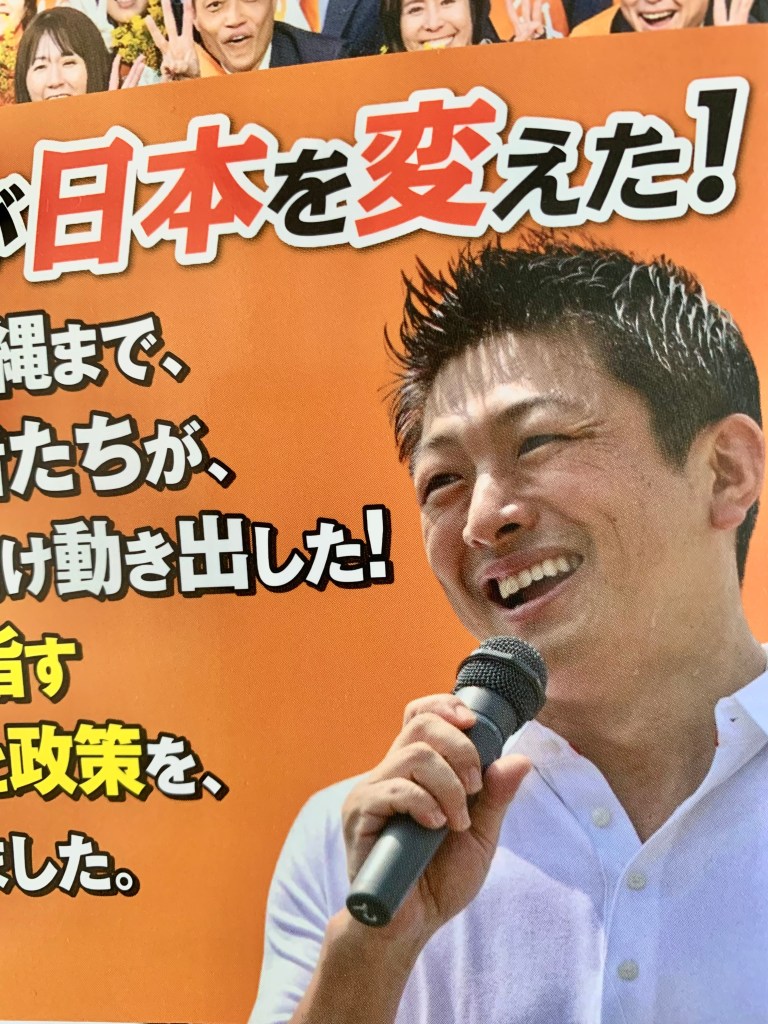
Photo 2: An undated photo of Kamiya, under a slogan that says “Sanseitō Changed Japan!”
No artificial intelligence or machine translation programs were used in the creation of this post.