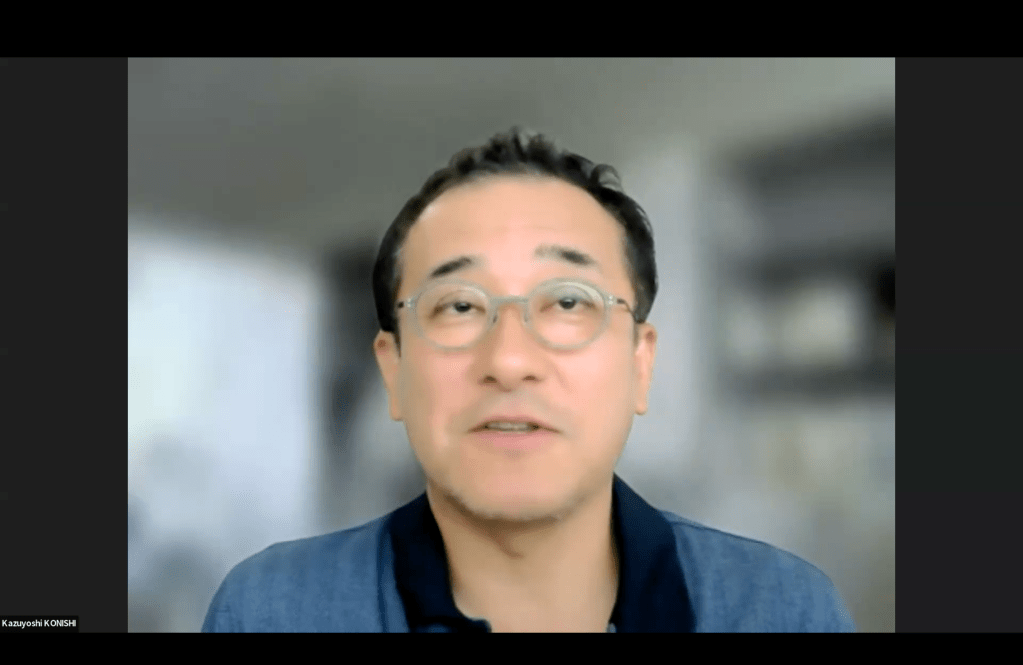
Interview in Japanese with political journalist and author Mr. Konishi Kazuyoshi. Some key takeaways:
- The ruling LDP, having strayed from voters, is losing its grip on power
- Factional vendettas inside the LDP are alienating voters
- Voters want LDP leaders like Ishiba to stay on and work with the opposition
- Populism is taking root in Japan, but not yet to the degree as in U.S.
- Japanese women do five times more housework than their male partners; this rather than economic factors is one of the true drivers of Japan’s tanking birth rate
- Trumpian transactionalism is forcing Japan to seek defense partnerships with other nations
(See below for his bio and an English translation of our discussion, which was shortened for flow and clarity.)
Konishi Kazuyoshi Bio
Konishi Kazuyoshi is a professor at the Chiba Institute of Science who specializes in crisis management. He is also a journalist and committee member on the Saitama City Gender Equality Promotion Council (known in Japanese as さいたま市男女共同参画推進協議会委員). Mr. Konishi joined the Kyodo News company after graduating from Keio University. In 2015 he was invited by the U.S. Department of State to visit the U.S. and participate in the prestigious International Visitor Leadership Program (IVLP). That month-long experience of representing his country in public diplomacy was a big turning point for him.
When Mr. Konishi was working as a political journalist in 2017, he took leave to become a trailing spouse and, with their two kids, moved to the U.S. for his wife’s work. He wrote extensively about this rare switch in gender roles, and even coined a new term in Japanese – chu-otto (駐夫) – for trailing husbands overseas such as himself. In 2024 The Japan Lens interviewed him about this experience. He is now the representative of Expat Friends of Husbands, which boasts 210 members.
Mr. Konishi was also a visiting scholar at the center for East Asian Studies at Columbia University. He engages in many activities for societal improvement, including writing, making appearances on shows, and lecturing extensively – giving input on gender-related issues from a male point of view, all in hopes of shifting Japan from a male-dominated society to one of gender equality, which Mr. Konishi views as crucial to Japan’s survival. He holds a Master’s degree in policy studies, and is the author of the book written in Japanese titled The Dilemma of Husbands Whose Wives Earn More Than Them (『妻に稼がれる夫のジレンマ~共働き夫婦の性別役割意識をめぐって』 published by Chikuma Shinsho.
Mr. Konishi also spent many years of his career covering the Executive Branch of the Japanese government, including the Prime Minister’s office and the Ministry of Foreign Affairs. The Japan Lens sat down with Mr. Konishi on 3 Aug. 2025 to hear his views on a range of issues in Japanese politics.
– – –
(Kafatos): There have been some surprising changes in Japanese politics recently, such as the results of the Upper House election last month. It appears the period of political dominance by the Liberal Democratic Party (LDP) is coming to an end. For those wanting to know how Japanese politics will change going forward, what should people be looking for?
(Konishi): The results of July’s Upper House election have the potential of representing a big turning point in trying to predict what will happen in Japanese politics going forward. There are three major points I would like to touch upon. First, what will happen to the LDP? More specifically, to Prime Minister Ishiba? As is clear to everyone, the election results were a stunning loss for his party. LDP-style politics has entered into new territory, and some might even say this is the beginning of the end for the LDP.
One politician who returned to the LDP and won the last seat, Suzuki Muneo, made some good points, referring to when he was campaigning throughout Japan. He said voters told him the following: “That slush fund scandal hasn’t been dealt with yet.” And that, of course, is totally correct. People were hoping Ishiba would take care of it upon taking office, but the reality is after fits and starts nothing came of it.
“Some might even say it’s the beginning of the end for the LDP.”
Konishi Kazuyoshi,
on recent election defeats
Now, a number of people calling for Ishiba to step down are former Abe faction members who were implicated in the slush fund scandal. And Suzuki’s point was that it’s bizarre that the same members involved in the scandal – the one never properly dealt with – are now calling for Ishiba to take responsibility for the poor election results. I think he has a point.
One of the primary goals of the LDP since its formation in 1955 has always been to remain the party in power. When it has fallen from power, twice since its formation, it’s shown itself to be fragile. And the party system has weakened with age, like metal fatigue in the support structures, in my opinion. The epitome of that was this slush fund scandal.
13 years have passed since the late Prime Minister Abe took office again for the second time. I think over the years a degree of arrogance in the LDP built up, as if, “No other party can be in power like us.” The LDP had a system based on distributing wealth and profits, thereby gathering gaining votes from all over the country. Then we had the slush fund scandal that caused a stink, and they sort of swept it under the rug to move on. And voters were repulsed by that, and said a resounding “No” to the LDP.
Second, I think Japan will now enter a period of coalition governments like in Europe. As of yet we haven’t seen other parties lining up yet to form a coalition with the ruling LDP/Kōmeitō bloc. But there’s more conflict as more parties arrive on the scene to challenge the incumbent. There is Sanseitō (参政党, the far-right Political Participation Party), and other conservative parties. The positive side to this emerging conflict is it means Japanese people’s thinking is diversifying. Some of these new parties are saying radical things, so I’m not sure we want that kind of diversity in the political space. But these new parties are in response to the diversification of the electorate. There’s a bit of a “chicken or the egg” quandary here. Are the parties arising from the people? Or are people joining the parties because they were formed? Regardless, the LDP-only system is starting to crack. And I guess you could take these developments as a sign the Japanese political system will, in some ways, become more European, with more parties forming coalition governments.
And third, there was the largest opposition party, the Constitutional Democratic Party or CDP (in Japanese, Rikken Minshutō or 立憲民主党). What’s going to happen to them? They’re still the top opposition party, but they seem to be losing that position. Some polls show them being displaced by upstart parties like Sanseitō. And at the end of the regular Diet session the other day CDP head and former Prime Minister Noda took the unprecedented step of not calling for a “no confidence“ vote against the LDP. Calling for such a vote has always been a largely symbolic action but this time – although we can’t say for sure – this time maybe it could’ve been different. Maybe such a “no confidence” vote would have passed. That’s because the LDP/Kōmeitō bloc are under the majority seat threshold in the Lower House. In the past the CDP always called for such a vote knowing there was little to no chance of it passing. It was like a ceremonial protest. This time it actually might have passed but Noda didn’t call for the vote. There was a howl of protest from lawmakers in his party, and many party supporters were also deeply disappointed.
As for the CDP’s results, it’s unclear but it seems they kept the same number of seats. It’s almost as if they were content to just perpetually criticize the LDP/Kōmeitō ruling bloc with no serious intention of doing anything else. Meanwhile, these upstart parties like Sanseitō kept growing and growing and now the CDP’s position as biggest opposition party is being threatened.
(Kafatos): In fact, many Japan watchers overseas were caught off guard by the rise of Sanseitō. It’s almost as if they suddenly appeared on the scene. Do you think this shows that populism has finally reached the shores of Japan? And is the Sanseitō brand of populism similar to MAGA-style populism? In other words, do you think these two forms of populism have more differences or more things in common?
(Konishi): I have also analyzed this phenomenon and, in essence, I think there are more differences than commonalities between the two. Let’s first look at what they have in common. Both are the result of populism, both are critical of elites. In the U.S. it was a definitive repudiation of Washingtonian politics and vested interests. They vilified multinational corporations, the incumbent party, and the left-leaning media. Japan’s Sanseitō also takes a hard view against the establishment party and the technocrats running the government in Kasumigasaki. They vilify the media and even faculty at universities. In that sense they are similar to MAGA in that they attract members by vilifying others. They say a lot of problematic and erroneous things but they basically want to take down the establishment and vested interests. I think these are the main similarities between Trump’s MAGA and the Sanseitō movement.
Sanseitō has also latched onto similar issues, such as vaccines for the coronavirus and the declining birth rate. They appeal to voters’ emotions, not their logic. Appealing to emotion is not necessarily a new thing, that’s what politicians do. But they take it too far and there are discrepancies in their logic. In the parlance of our times, it’s like they’re living in a “parallel world.” They write off facts as fake and gather more allies to their movement.
But, of course, Sanseitō and MAGA also differ. The MAGA movement is largely driven by the presidency, by this larger-than-life figure named Trump. Also, his administration is now in power. It’s doubtful the leader of Sanseitō is as distinguishable as Trump. Another difference is MAGA got its start originally in places like Pennsylvania but now Trump supporters have spread all over the country, even to blue states. In contrast, Sanseitō has yet to become that strong. Their influence is still limited.
Also, the scale of the movements is different. MAGA is about making America great again, it’s a nationwide movement. But with Sanseitō, if it tried to be something like “make Japan great again” that would have a different meaning. They do talk about reclaiming the Japanese spirit and pride in being Japanese, but they don’t talk about what they’re going to do for the whole country. So I think the scale of these two movements is pretty different.
“Almost no one watches TV news and nobody reads the paper. It’s all social media now.”
Konishi Kazuyoshi,
on how young people get their news
(Kafatos): But both movements spread largely due to social media, as with other populist movements throughout the world. And supporters seem to abandon conventional media and get their news from other sources, such as YouTube and Line. In the U.S. they say a free press is the guardian of democracy. What do you think Japanese media should do in light of this social media trend?
(Konishi): Yes, as I commented earlier, traditional or conventional media is now being viewed as the enemy. And in both the U.S. and Japan there is a strong link between populism and social media. That trend started in the U.S. and has now reached Japan’s shores. Sanseitō now considers traditional news companies the same as the established political party, in other words, they’re the enemy. This dissatisfaction showed itself in the election where voters dealt a defeat to establishment parties. As for the media, this antipathy manifests as lost consumption. In other words, no one is reading those newspaper articles or watching those news shows. They’re getting their news from social media.
In my classes I sometimes ask students, “How many people here watch the TV news? How many read the newspaper?” Answer: Almost no one watches TV news and nobody reads the paper. It’s all social media now. For example, they read Line News or “X”, formerly known as Twitter. These students are in the 18-20 year-old range. They don’t consume that old-style news media at all. So, like the established political parties we talked about earlier, I think Japan’s traditional news media is standing at a crucial point.
One thing I watched carefully for this past election was the concept of equal coverage for all political parties. Giving each party equal coverage has been standard practice for Japanese news companies, whether in terms of equal air time on TV or equal print space in an article. But one result of covering campaigns that way was like what we saw in the governor election in Hyōgo prefecture. The media realized after that election that it was problematic to be overly neutral, to just cover all statements equally. There was this shift to calling politicians out, and a new willingness to cross the strict barriers of neutral reporting.
For example, we saw more fact checking, a media practice that started in the United States. In the past, there was a tendency for Japanese news shows and newspapers to tie their own hands with the binds of excessive neutrality. And this time there was some soul-searching where the conclusion was, “We can’t do that anymore.” And media regret over its coverage of the Hyōgo election played a big part in that. This sense that, if something is fake then it needs to be called out as such, and we shouldn’t be so concerned about how many seconds are equally distributed in covering each party. I think that was a very big step forward for us. I don’t think we will retreat from that or go backward. I think that was a very good development.
You know, covering everyone equally is actually easier for journalists. If they tell me I have 15 lines to write about each party then, as a journalist, it’s kind of easier for me to just do that. But, from the standpoint of better news value, adjusting coverage is the right thing to do, and I think it’s a big deal Japan’s news industry is entering into this new territory.
I would like to show you some data about Prime Minister Ishiba. This is a survey conducted by the Asahi Shimbun in late July. The question asked was, “Should Prime Minister Ishiba step down?” And the overall results were 50-50, half saying yes and half no. 70% of LDP supporters said he should not step down. And look here: 60% of supporters of opposition parties said the same thing.
“Voters want to continue with the LDP/Kōmeitō ruling bloc, but they want them to join and work with opposition parties.”
Konishi Kazuyoshi
Another question was: “Do you want to see a change in administration?” And respondents said “no.” Voters want to continue with the LDP/Kōmeitō ruling bloc but want them to join and work with opposition parties. As for the LDP loss, voters took issue with structural problems such as the slush fund scandal in the LDP. Support for the Cabinet has dropped, which is a puzzling given the other responses. Anyway, as I wrote in my commentary, last year‘s Lower House elections had very peculiar results.
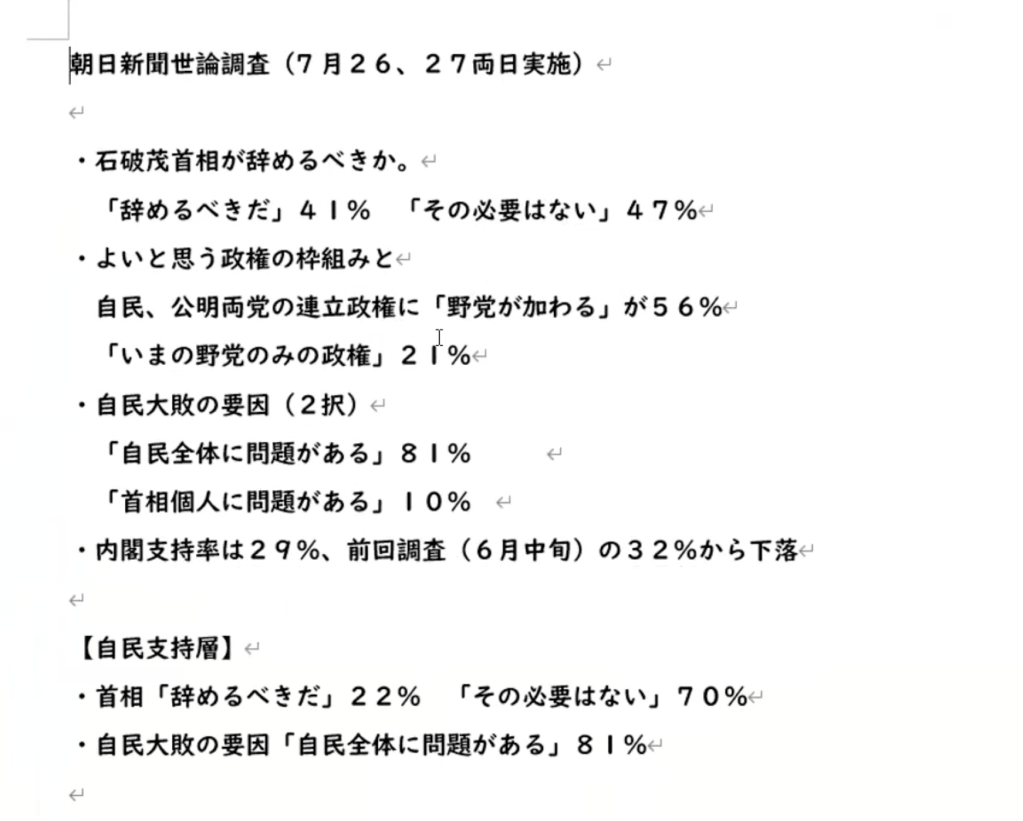
Asahi poll showing 81% of respondents think the party – not Ishiba – is at fault for LDP losses
(July 26-27, 2025)
And I think voters sent the same message with these elections in the Upper House. And ordinarily, when a party does so poorly in elections, it’s customary for the president of the party – in this case Ishiba – to take responsibility and step down. But I think there was this sense amongst voters that if they got rid of Ishiba that would just mean going back to the old LDP. And what the supporters of both ruling and opposition parties – not the lawmakers but the voters – seem to be saying is, “Ishiba, stick around. Engage in discussions with opposition parties, work together, and move politics forward.” And I think that’s the message. Let me show you some other numbers that support this conclusion.
Here, 41% of all respondents said Ishiba should step down but 47% said he shouldn’t. 56% said “an ideal administration” would comprise the LDP/Kōmeitō ruling bloc plus opposition parties. As for questions regarding what the problem with the LDP is, 80% replied it’s the party. And when they posed the same questions to LDP supporters, 22% said Ishiba should step down 22% but 70% said no. Also, they clearly said the election defeat was not Ishiba‘s fault. 81% of LDP supporters said the fault is with the party itself.
So what’s happening here? You have those politicians clamoring for Ishiba to step down but that is at odds with what voters want. In other words, there’s a big disconnect between what the politicians are doing and what the voters want them to do. They say a country’s politics shows a lot about the national character. And it seems to me that in Japan the will of the people has moved forward, progressed further than the political establishment that serves it.
Many of the people calling for Ishiba to step down are the same ones who were involved in the slush fund scandal. These people embody the “old LDP.“ But voters showed definitively in these past two elections that they want a different kind of politics. It’s my analysis that those politicians of the older era are not keeping up with how fast the electorate is changing, nor with the will of the people. It’s still hard to say definitively at this point, but that’s what it looks like to me.
“The majority of respondents – regardless of party affiliation – said they don’t think Ishiba should step down.”
Konishi Kazuyoshi
(Kafatos): Ishiba is a leader who came into office with the strong support of the public but weak support within his own party. And some say voters were greatly disappointed that he was not harsher on these lawmakers involved in the/fund scandal. Do you think that’s an accurate portrayal?
(Konishi): Yes, obviously that was the case. But voters do not seem to be telling Ishiba to take responsibility for that mistake and step down. We’re talking about Ishiba here, the man who ran for the premiership five times. And everyone, even those in the opposition parties, had a lot of hope in him. And it seems that even now, even after all this, some of that is still there. They’re hoping he will do something different with the LDP. So even though he may not have handled the slush fund punishments in an ideal way, they still want him to keep at it. They want to believe in him, maybe because there really isn’t anyone else. Note the interesting results in the poll. The majority of respondents – regardless of party affiliation – said they don’t think Ishiba should step down.
Many are saying that people who used to support the LDP have drifted to other parties such as Sanseitō. And that’s because of conservative thinking, that the LDP is getting further and further from its conservative roots. And they say since hardliners went to other parties, the LDP now has a higher concentration of the type of voter that would support Ishiba.
However, as seen with the issue involving, say, a woman choosing to keep her maiden name in marriage, only Japan has fallen behind other advanced countries with this issue. Today’s LDP cannot even form a coherent opinion on the issue. And some critics say this is a liberal issue, but is it? Is it a conservative issue? In my opinion, it’s just a matter of choice. I mean, if you don’t want to keep your name then don’t. It’s like they’re imposing themselves on someone else’s personal values. If conservatives drifted to Sanseitō because they felt the LDP was not conservative enough in its stance, I guess that would support the idea that hardliners are abandoning the LDP. But I think it’s still hard to say definitively.
(Kafatos): There are news reports saying LDP Secretary General Moriyama Hiroshi will take step down to take responsibility for the poor election results, thereby clearing the way for Ishiba to continue. What kind of plan do you think the administration has right now?
(Konishi): Right now that is the biggest topic of interest in Japanese politics: what will Ishiba do next? I think he was greatly heartened by the results of these recent polls. He may feel vindicated, and certain those trying to push him out are wrong. He may take his next action based on that belief. I also think he finally managed to become prime minister after five tries so I don’t think he will give up very easily. If I had to guess what he is thinking in his heart of hearts, I would say he might be telling himself, “If I don’t stand firm, it’s not just the LDP but the country as a whole that could head in a bad direction.” I think he strongly believes that.
Maybe in a way he thinks of himself like a dam, where there’s this huge flood of water coming from upstream to sweep him away. But he alone is holding them back. And, in fact, support numbers for his Cabinet are rising somewhat. Little by little. Those poll results we discussed have probably boosted his confidence. I bet he feels like this is some kind of test of his will.
“If a prime minister doesn’t want to go, it’s pretty hard to make him.”
Konishi Kazuyoshi,
on pressure for Ishiba to step down
And, as you know, August is a very important month in Japan. There’s the anniversary of the bombings of Hiroshima and Nagasaki, and of the end of the war. And in Yokohama the PM has to attend the international conference at the end of the month. Most people are talking about when in September he might step down. But I think this is a man who slowly and deliberately plays the power game. So, if you allow me to make a bold prediction here, I think he will try to stay on.
Mainstream opinion says the Ishiba administration won’t be able to function without Moriyama. But if Ishiba succeeds in winning over three more legislators in the Upper House from other parties – the three he needs to get a majority – then he might be able to form some kind of coalition. Of course there are a lot of unknowns in politics. But one thing you can say is this: if a prime minister doesn’t want to go, it’s pretty hard to make him. I have seen that many times during my career.
Getting back to the matter of the U.S., Ishiba strongly believes he mustn’t leave trade matters unfinished. He sent his trusted advisor Akazawa many times over to the U.S. and finally secured a deal for 15% tariffs on Japanese goods. And it’s meaningless to speculate now but, had he secured that deal during the campaign, it could have resulted in a better outcome for the LDP. His administration slid into homebase at the last minute for the August 1 deadline. And in terms of content, both the LDP and opposition parties – as well as the finance world – have said the deal was largely a success. That also has probably boosted Ishiba’s confidence.
(Kafatos): The issue of low birth rate is extremely serious in Japan, although many advanced nations struggle with it. In the course of engaging in various activities – to change Japanese workplace culture, do away with onerous overtime, and the like – what have you found? Which of Japan’s parties, if any, has an effective plan for dealing with this issue in your opinion?
(Konishi): I don’t think any party has come up with a clear solution to this problem. And the Japanese government has talked about all it’s done but it’s yielded no results so far. Here’s part of a presentation I used in my class.
The Japanese population peaked in 2004. And you can see how precipitously the birth rate is falling. The annual birth rate in 2024 fell for the first time ever under 700,000 babies, which means the number of babies the average Japanese woman can expect to have in her lifetime now averages 1.15. The declining birth rate and aging population issue is worsening at an incredible rate.
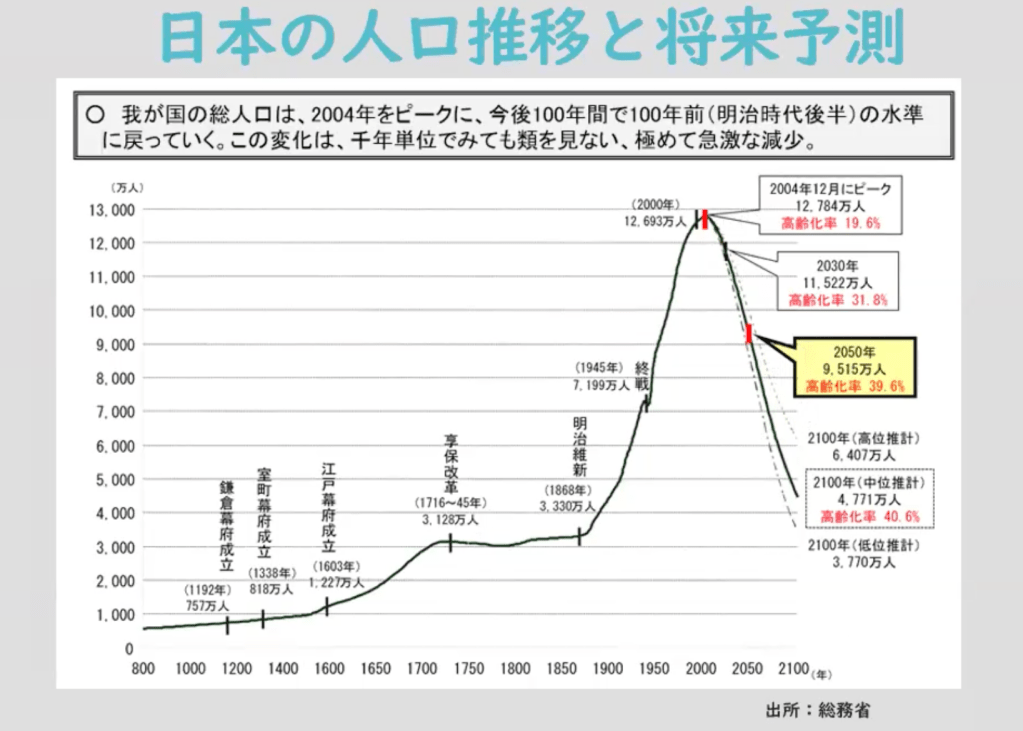
Japanese births peaked in 2004 and have been dropping precipitously ever since.
I was born in 1972 and the annual birth rate back then was over 2 million. Today that’s dropped to just one third of that. One good thing is there is probably now less competition to get into the good schools. But, setting that aside, I think there are various reasons for why people are having less than less babies.
I think the government is placing too much emphasis on economic factors. It’s as if they think if they provide money, if they are more generous with child allowances or making school tuition lower, then people will have more babies. But that’s not all that’s involved in this. There’s also the issue of workplace culture, and also more and more people are not getting married. Look at this chart showing marriage rates. See how they are dropping? And one of the reasons is, of course, the issue of being able to choose separate family names. By law, if someone gets married, they have to abandon their family name. People who want to get married but don’t want to lose their family name are put off by this, and avoid getting married.
“I think the government is placing too much emphasis on economic factors. It’s as if they think if they provide money … then people will have more babies.”
Konishi Kazuyoshi
But in my opinion, this is where we should be focusing. Factors such as gender inequality and division of housework. The house chores and child rearing duties fall disproportionately on the woman. Look at this chart on house chores. Japanese women do five times more housework than their male partners.
(Kafatos): Do young women look at this – and what their mothers and grandmothers had to go through – and say, “No thanks, I don’t want to do that.” Is that why they are rejecting marriage and having kids?
(Konishi): Yes, there’s definitely some of that. Their mothers and grandmothers are their biggest role models after all.
There’s also the fact they want to work, but they can see their partner will not help at home to make working possible. And so when men say, “Oh I have to work late today” and then don’t help around the house, that adversely affects the mothers. And even if a couple has a child there’s a big hurdle to having a second child. Here you see the case where they had a baby, but then they saw how little their male partner did to help out at home. That will naturally put a damper on their desire to have a second child. A woman in this position says, “It’s been so hard for me with just one child. I can’t imagine how hard it will be with two!”
I think this is a very big factor. There’s this term now, “the high wall preventing couples from having a second child.” Like it says here in the survey, women struggled with just one child and couldn’t get support from the male partner for housework and childrearing.
And getting back to the political discussion, the government hasn’t come up with an effective response to this crisis. And I think it’s hard to find a party that has some kind of effective policy. I think the declining birth rate requires a crisis management solution. Actually, I am faculty at the school of crisis management studies at this university and I am moving forward with various research topics.
Other countries are having some success with this issue. Germany is a good example of a country having some success. Here what’s noteworthy is they (the German government) provides a parents allowance, not a child allowance. Insofar as they are handing out money, it’s the same. But they also reduce work hours in order to help parents have enough time to raise their kids. And provide them with a lot of pay. In Japan, the government pays an allowance to parents for child-rearing expenses, which is different from the German system. I think Germany can be a good reference point for us when trying to improve the situation here in Japan. Also, in Germany the distribution of housework is much more even than in Japan. German men are pretty committed to taking on tasks at home.
(Kafatos): The U.S.-Japan relationship has changed a lot. The Trump administration favors deals over friendships and alliances. How do you think the U.S.-Japan relationship will change? Or should change?
(Konishi): With the start of the second Trump administration I think it’s safe to say security issues in the U.S.-Japan relationship have become clearer. Trump has called Japan a free-rider. Trying to change the president’s mind regarding the nature of the relationship looks largely impossible. Up until now, when it came to the U.S.-Japan security agreement, Japan didn’t really have to do much thinking. But now this president, who says things others never did, has appeared yet again.
And I think Japan has now entered a phase where its security arrangement has to be a “U.S. plus alpha” option. Japan is now working to engage in 2+2 dialogues with other countries and to create frameworks like the Quad with India and Australia. It’s now necessary for Japan to strengthen those other non-U.S. avenues. It now needs to be not a U.S.-centric framework, but a multinational framework for Japan’s security. Of course that’s with the assumption that Article 9 of the constitution remains the same. We have to switch from the paradigm where the U.S. was protecting Japan now to a new way, which means Japanese thinking about its own security and about how to become more independent in defending itself. Of course this is all predicated on the U.S.-Japan alliance being the most important piece of Japan’s security. But there’s this sense now that we can’t just rely on that alone anymore.
There are a lot of uncertainty factors in East Asia. Lots of countries with various governing systems in Japan’s neighborhood. The late PM Abe took the first step toward realizing these new security measures; now it feels like it’s time for the second.
“The reappearance of Trump afforded us the opportunity to think about our own security.”
Konishi Kazuyoshi
This (Trumpian) concept of making a deal in the realm of security seems strange. But that’s the thinking of the world’s most powerful leader. We have to new alliance, whereby we focus more on the “alpha” part of the equation – that is, countries besides the U.S. with whom we can have security ties. Geopolitical realities being what they are, what can the Japanese government do to protect the national interests? That’s something everyone will have to come together and think about, both the ruling and opposition parties.
(Kafatos): Ishiba said something like no other country in the world has a Status of Forces Agreement (SOFA) as unfair as the one we have with the U.S. I think many people will be watching to see how the relationship unfolds, especially in the area of defense.
(Konishi): It’s not a relationship of equals. Natural, perhaps, given how much stronger America’s military is. And if you tried hard to focus on the half-full part of the cup, I guess you could say the reappearance of Trump afforded us the opportunity to think about our own security.
– – –
More information on Konishi Kazuyoshi and his many achievements can be found at the official Konishi Kazuyoshi website and on his X account. The Japan Lens thanks him for his time and invaluable insights.
Photo 1: Konishi Kazuyoshi speaking with The Japan Lens on 3 Aug. 2025.
No artificial intelligence or machine translation programs were used in the creation of this post.


 The Japan Lens
3 responses to “Interview with Konishi Kazuyoshi: “The old LDP isn’t keeping up with the will of the people””
[…] (インタビューの英訳はこちらへ。) […]
LikeLike
[…] インタビューの英訳はこちらへ。 […]
LikeLike
[…] […]
LikeLike