Audio recap of this week’s top Japan stories:
Synopsis:
- Alliance mechanisms are being leveraged by Trump against Japan
- Japan reacts poorly to Trump’s aggressive negotiating style
- Tokyo increases moves to be less reliant on U.S. for defense
- Trump doubles down with more tariff pressure
1 July 2025 (Tuesday)
The Quadrilateral Security Dialogue, or Quad as it is known, met in Washington, D.C. last Tuesday to discuss issues pertaining to the defense framework. The Quad, which was the brainchild of the late Abe Shinzō, was originally created years ago in hopes the four likeminded nations – the U.S., Australia, India, and Japan – would be able to marshal resources to counter China’s massive influence in the Indo-Pacific. Even now, the framework retains its hard edge toward the PRC. The U.S. Secretary of State, Marco Rubio, and the three foreign ministers issued a statement warning of China’s increasingly bellicose behavior in the South China Sea.
However, as seen in the headline in Nikkei Asia, which said, “Rubio wants Quad to deliver results, starting with critical minerals,” the Quad is now being influenced by the more transactional policies of the Trump administration. This has caused friction between the U.S. and its three Quad partners. India, for example, is upset at how the Trump administration has embraced Pakistan despite a recent outbreak of violence over Kashmir. Australia, which was to receive crucial submarine technology through the AUKUS agreement – partly to help counter China in the vast Pacific – now finds itself the subject of an American review which might terminate the deal. And Japan, America’s closest ally in East Asia, now finds itself under intense pressure to make massive concessions in trade negotiations, or else face 25% tariffs on any exports it sends to the United States.
2 July 2025 (Wednesday)
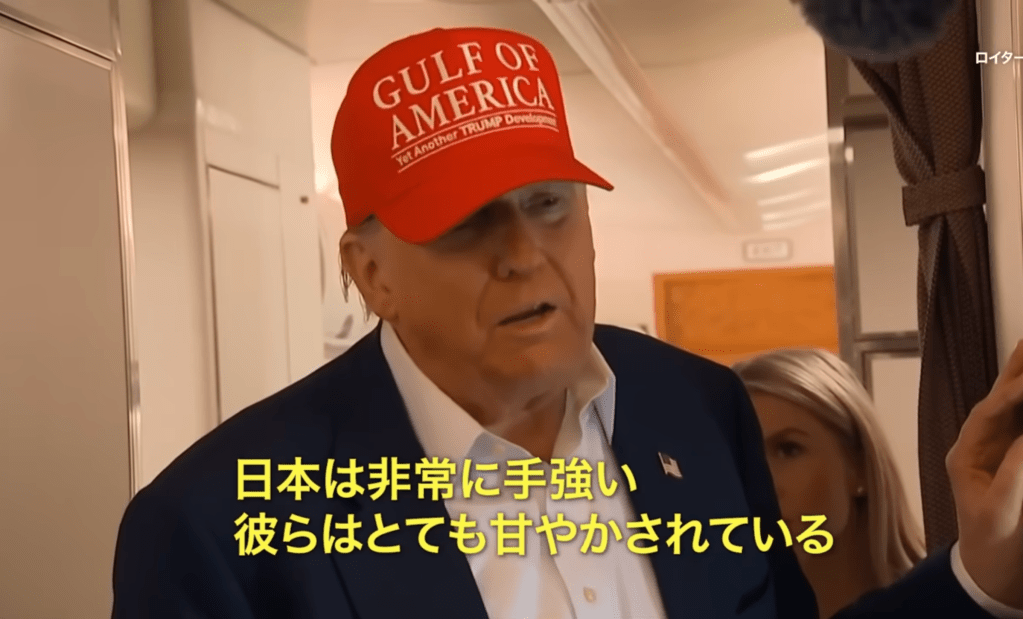
As if to underscore this point, U.S. President Donald Trump gave a short interview where he called Japan “very spoiled.” This comment was in reference to the president’s stated belief that the U.S. has been taking care of Japan in terms of defense for years, even though, in his opinion, Japan has neither paid its fair share nor conceded on trade. America’s annual trade deficit with Japan stands at about $68 billion, however, many economists doubt tariffs are the way to do away with such deficits. And it is not clear if this is even what the president truly believes, or if this is just part of his negotiating tactics – which are said to involve putting intense pressure on the other party in order to get them to bend to his will.
“I have to say, they’re very spoiled…”
U.S. President Donald Trump, speaking about Japan
What is clear, however, is that the Japanese translation being used to convey what the president said about Japan – “I have to say, they’re very spoiled” translated as Nihon ha amayakasarete kita – comes across as condescending. It is a term often used to refer to overindulgent parents who let their kids do whatever they want and run amok. This comment, which was probably meant to pressure Prime Minister Ishiba Shigeru to cave in to Trump’s trade demands, has elicited a torrent of angry responses in Japan.
It would be ironic if Trump’s comments have the opposite effect, i.e., making it politically impossible for Ishiba to compromise. Ishiba is under intense domestic pressure – from both the left and right sides of the political spectrum – to stand strong against what is widely perceived to be American bullying. But many also blame the Ishiba administration for the dismal state of affairs.
3 July 2025 (Thursday)
In a related development Trump’s treasury secretary, Scott Bessent, gave an interview on Thursday where he was quoted as saying the following: “Japan are (sic) great allies, and they are in a tough spot right now. They have an Upper House election on July 20, which I think gives them a lot of domestic constraints in terms of doing a deal.”
The Japan Times ran a story with the headline “Japan-U.S. tariff negotiations enter unchartered territory.” In it, Francis Tang discussed Bessent’s interview and his reference to the July 20 Upper House elections. It can be reasonably inferred that Trump and his advisers are conscious those elections could make or break Ishiba and his administration. Japanese officials in Tokyo probably don’t feel like they are being treated as “great allies.” For the Japanese government, and particularly for Ishiba, Trump has turned the handshake of a friend – in other words, the alliance with the U.S. itself – into a painful arm twisting that could literally end his premiership.
4 July 2025 (Friday)
On this day, American Independence Day, Yahoo Japan featured a story by the Chuō Nippō with this headline: “President Trump: ‘Japan is spoiled,’ reciprocal tariffs lèse-majesté?” (This term refers to when a monarch punishes a subject for insulting him.) The article features in-depth analysis of Vietnam’s recent deal with the Trump administration, which has caused ripples throughout Asia. It includes commentary from Korean analysts, who concluded Vietnam’s willingness to compromise quickly and early may have raised the country’s standing in Trump’s view. But it also posits that what pleased Washington might have angered Beijing. In other words, Vietnam’s deal with the Americans could result in punitive measures from the Chinese.
As for Japan, the analysis drew the following conclusion in contrast with Vietnam:
“On the other hand, since Japan was not proactive in responding to U.S. demands, Tokyo might be subjected to punishment from Trump. He might make an example of Japan for other major nations, with the intent of making those (trade) negotiations go in his favor.”1
6 July 2025 (Sunday)
In defense-related news, an article appeared in the South China Morning Post about the Japanese Self-Defense Forces. The article, which was titled “Why Japan tested a missile on its own turf for the first time,” reported the SDF tested a surface-to-ship missile in Hokkaido last month, something it only used to do in the U.S. or Australia. Japan is increasing such activities, which means it is doing less testing on U.S. bases and more elsewhere, partly in response to the Trump administration. Japan’s testing is an important source of income for U.S. bases.
7 July 2025 (Monday)
Then, two days prior to his own deadline of July 9, Trump released the content of official letters addressed to the leaders of South Korea and Japan. The content of the letters were substantially the same; the one addressed to Prime Minister Ishiba was posted on his social media platform, Truth Social, after around midnight Japan time. The CNBC’s headline of the story was: “Trump announces 25% tariffs on imports from Japan and South Korea, starting Aug. 1.” In the letter, Trump cites lack of reciprocity for the reason for raising tariffs. He also says that if Japan dares to levy tariffs of its own against U.S. products, that amount would be further added to the 25%.
8 July 2025 (Tuesday)
The response from Tokyo was predictably negative. As reported by an article in today’s The Japan Times with the sub-header “Art of the deal or act of betrayal?” Japanese officials felt blindsided since they quickly tried to show the White House they were taking the U.S. president’s concerns seriously. Despite that, Trump slapped the same 25% on Japan as he did other countries. Officials were particularly angered by the same copy-and-paste wording used for letters sent to several countries. And in another article titled “Japan stands its ground” The Japan Times quoted LDP policy chief Onodera Itsunori (who has traditionally favored more defense collaboration with the U.S.) as saying:
“Notifying us with just a single letter is extremely disrespectful to an ally…”
Onodera Itsunori, LDP policy chief
Looking at some other nations might be instructive at this point. In Canada and Australia, politicians who stood up to perceived bullying from the U.S. president saw themselves rewarded with higher support from their voters. And at the moment, PM Ishiba does not have the strong support of Japanese voters. They say his premiership is teetering, and having the leader of his nation’s most important ally yank the rug out from under him during negotiations has to be unnerving.
What will be interesting to see is whether this type of haranguing from the Trump White House will result in a “rally around the flag” effect for the Japanese PM. If it does, this disastrous announcement could end up becoming a blessing for Ishiba. But if it doesn’t, then Trump’s actions might contribute to the death of Ishiba’s premiership. Things will become clearer around the 20th of July when the Upper House election will be held.
– – –
1Chuō Nippō. 2025. “President Trump: ‘Japan is spoiled,’ reciprocal tariffs lèse-majesté?” (トランプ大統領は「日本は甘やかされている」、相互関税「不敬罪」追加). Chuō Nippō. 4 July 2025. 「半面、日本は米国の要求に消極的だったため『不敬罪』が作用する可能性がある。日本を見せしめにして他の主要国との交渉を有利に導こうという意図もみられる」と。
Photo 1: U.S. President Donald Trump responds to questions from reporters about Japan.
No artificial intelligence or machine translation programs were used in the creation of this post.