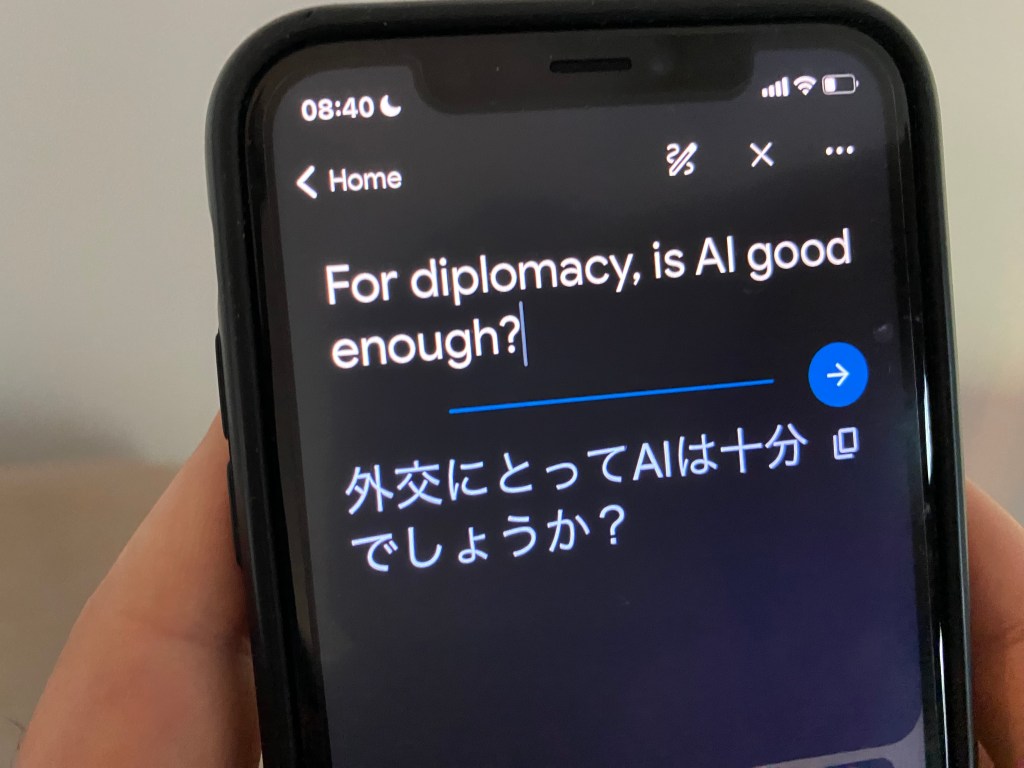
It is impossible to avoid the hype surrounding artificial intelligence these days. Given the speed with which A.I. is flooding into our workplaces, many in the business world feel pressure to get onboard or risk being swept away. This is also becoming true for U.S. officials, who often have to conduct the nation’s diplomacy with non-English-speaking interlocutors. This article is for those public servants who may be wondering what role, if any, A.I.-powered language tools can play in U.S. diplomacy.
Initially, as a disclaimer of sorts, I am not a specialist in A.I. nor a current professional user of A.I.-powered tools.* However, as seen in my bio, I have experience as both a professional translator and interpreter. My working languages are Japanese and English. I worked as a technical translator for ten years, some of them using machine translation tools (MT). Later, I got a Master’s degree in conference interpreting, and served for 5.5 years as a diplomatic interpreter at the U.S. Department of State’s Office of Language Services. All told, I have almost 15 years’ of experience interpreting at all levels of government, primarily in the Executive Branch. That said, I am certainly not in any position to express official policy stances, neither on behalf of the U.S. government nor my industry. This post is just a summary of my personal opinions based on my experience. I hope it will be useful to U.S. diplomats trying to get their bearings in the A.I. storm.
The main question I intend to address is this: What should U.S. diplomats and policymakers consider when confronted with the prospect of using A.I.-powered tools for diplomatic interpreting? In this first of a two-part series, I will present three of six suggestions for how we might consider the issue intelligently and responsibly.
(1) Know what you don’t know
To American public servants primarily working in a domestic capacity, there is no shame in not knowing much about the language industry. The truth is, even foreign service officers (FSOs) know very little about language translation and interpreting. These are two highly specialized fields requiring years of study and experience. Common misperceptions include interpreter is just another word for translator, and any bilingual can “translate.” Neither is true.
For the purpose of this piece, just know both translators and interpreters take one language and convert into another, but the similarity ends there. Translators work with written words (e.g., documents), interpreters with spoken words (e.g., spoken speeches). If it’s still unclear, check out this short video by the American Translators Association (ATA).
Also, if you are a U.S. official tasked with setting up bilaterals and multilingual meetings, you should familiarize yourself with the basic interpreting modes. Don’t be afraid to ask your language specialists questions like these:
- What do your interpreters need from me to do a good job?
- When is it better to use consecutive interpreting versus simultaneous? In-person versus remote?
- What are the benefits and drawbacks to each mode?
- Given the desired outcome of our meeting, which mode would you recommend?
U.S. officials need to know these basics, or at least the basic questions to ask. Simply put, ignorance about interpreting is dangerous. Many foreign interlocutors have taken note of American ignorance on this subject, and some even try to twist the mode of interpreting for propaganda purposes. That is why knowing the basics is crucial to effective diplomacy, and to making smart choices about how A.I.-powered tools might someday be used in multilingual settings.
(2) Separate the hype from the hypothetical
Next, familiarize yourself with the latest technological developments in A.I.-powered tools. One of the biggest breakthroughs has been A.I.-driven interpreting, as showcased in Wired magazine, which recently conducted an experiment with A.I. vs. human interpreters.
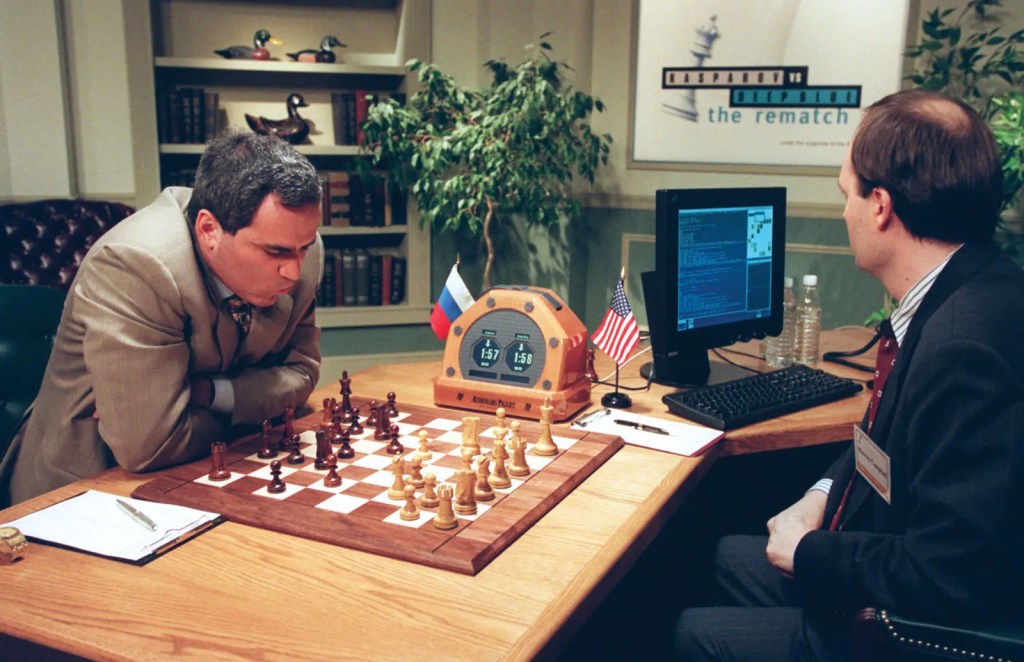
It was like the foreign language version of the chess showdown between Kasparov and IBM’s Deep Blue in 1997 (pictured here). Take a few minutes to watch the Wired video. You will see the A.I. performed well, but the results were deemed insufficient for the quality needed in diplomacy.
One of the A.I.’s shortcomings was how it mechanically interpreted each and every word, creating situations where sometimes the forest was lost for the trees. Incidentally, some human interpreters pedantically insist on interpreting this way. They mistakenly believe they are being faithful to the speaker’s message, but listeners are often left to sort out what it all means. Interpreters who robotically interpret word-for-word are usually considered inexperienced and ineffective, especially when interpreting between high and low-context languages like Japanese and English. The art and science of interpreting isn’t just about addition. It also involves highly precise subtraction, not to mention careful rephrasing.
There are other impressive A.I. programs, some using both audio and visual components. HeyGen is a good example; it can interpret speakers in a video into other languages. It can also lip-sync the speaker’s image so their mouth looks natural “speaking” the other language. Take a look at this example and you will see the speed of progress is dizzying. Tech like this looks so cool and effortless, one could be forgiven for thinking U.S. diplomats will soon be setting a laptop with A.I.-powered tools between our secretary and the other side’s minister. But the reality is much messier. Take, for example, the mayor of New York, Eric Adams, who used A.I. to “translate” (sic) himself speaking in multiple languages. The NPR article reporting on this ill-advised action didn’t even think to ask the biggest question, which is, “Did anyone make sure the output in the other languages didn’t sound ludicrous?” Probably not.
Unfortunately, when it comes to translating and interpreting, many laypersons make poorly informed decisions like these. The simple fact is this: While many of these A.I.-powered tools offer a high degree of utility, they can also entail an unforgivable amount of risk. Is A.I. ready for primetime? When the stakes are high – as they almost always are in diplomacy – the answer is simple: no. This is especially true when the discussions require a deep knowledge and understanding of national security and cultural context, which is to say, almost all diplomatic discussions.
(3) Discern where A.I. can be used
That doesn’t mean A.I. should be dismissed entirely. A scene in the hit HBO series Succession illustrates this point nicely. In the last episode, Swedish tech execs control the fate of Waystar Royco, a sprawling media empire. They speak openly about their nefarious plans in Swedish, confident that Greg, the American, doesn’t understand them.

But Greg, sensing the conversation is important, inconspicuously opens an audio-enabled translation app on his phone. Thanks to that, he gets the gist of their conversation and changes the course of events. If nothing else, that scene should serve as a wake-up call to people who arrogantly speak in their languages thinking others don’t understand.
Granted, this example with Greg is make-believe. In real life, no one would base make-or-break business decisions on the spotty output of a free translation app. Nevertheless, these apps have useful applications. On a recent work trip to Japan, I witnessed a five-minute exchange between a British traveler and a Japanese ticket agent at a train station. Neither knew the other’s language, but they were able to communicate almost seamlessly thanks to an audio-enabled translation app on the traveler’s phone. It even facilitated a nice personal moment. The traveler ended the exchange by earnestly saying to the agent through his phone, “Thank you so much for all of your help,” which came out a little strange in Japanese but got a big smile out of her anyway. Clearly, this is an ideal scenario for using such apps. They offer a high degree of utility in situations where the stakes are low (what I classify as “high-utility, low-risk usage”). They have spread all over the world precisely because of their usefulness. There are few if any interpreters who don’t accept this obvious fact.
In fact, interpreters working at diplomatic meetings sometimes use A.I.-powered tools themselves. For example, some use them to translate unclassified and non-sensitive PowerPoint presentations, especially when there are many slides to go through. Granted, the output is never perfect, but it quickly gives the interpreter a rough idea of how to phrase the presenter’s thoughts in the other language. Automating that bit frees them up to focus on the really difficult stuff, such as how to fluently and accurately express concepts and ideas that don’t even exist in the other culture. This is another good example of high-utility, low-risk usage.
Simple correspondence about scheduling or logistics can also probably be conducted using these apps, although multilinguals on both sides should confirm no mistakes have been made, and sensitive content needs to be safeguarded. Another potential area of use is drafting meeting minutes, or transcribing official discussions or phone calls. Even “dumb” non-A.I. tools can probably be used here, provided they have high-quality voice recognition and dictation functionality. Needless to say, the output has to be double-checked using easily executable but highly reliable confirmation processes. And, as always, precautions need to be taken for sensitive content.
In the second installment of this piece, we will look at three other points diplomats and officials should keep in mind when considering A.I.-powered tools in multilingual diplomacy.
– – –
*The term “A.I.-powered tools” is used here to refer to both language translation and interpreting platforms, since the technological line between these has blurred due to upgraded voice recognition and audio functions.
**Please note, this piece is written in the context of U.S. diplomacy, but many of these principles apply to all diplomatic interpreting, regardless of nation.
Photo 1: Screenshot of a free and widely available machine translation (MT) app.
Photo 2: Chess master Kasparov was defeated by IBM’s supercomputer Deep Blue in 1997. (Encyclopedia Britannica)
Photo 3: Nicholas Braun plays Greg Hirsch in the hit series Succession. (The Atlantic)
Note: No artificial intelligence or machine translation programs were used in the creation of this post.




One response to “To U.S. Diplomats (1 of 2): A.I.-powered language tools in diplomacy”
[…] In the last post, we discussed how high-utility A.I. can be useful for translating or interpreting in low-risk situations. We also looked at how even the latest A.I.-powered language tools* are not up to the job when it comes to diplomacy since too much is at stake. In this post, we will delve a little deeper into intercultural communication to understand why diplomatic interpreting isn’t just about mechanically translating words or phrases. […]
LikeLike